"60 000 times faster than text" ... Really?

I just got an email from Alan Levine. He's sniffing around for the origin of the quote many folks have often used, myself included, that we process visual information 60 000 times faster than text.


Here's what Alan said:

I need your help. I have found an assertion repeated on thousands of web sites, and repeated so often that it is cited as a fact, yet I have tried and tried and have been unable to locate the actual source of this claim:
Research at 3M Corporation concluded that we process visuals 60000 times faster than text.

In the interest of dogged pursuit, information literacy, and all that we value as scholarship (okay I am laying it on)- can you help me find the answer? Or spread to someone who can?


Here's what I found ...

I started with the search engine millionshort.com by eliminating the first million hits from Google I circumvented the lions share of SEO (Search Engine Optimized) sites and took a first stab at the deeper web.


The 6th & 7th link struck me as worth following, the 7th link included a citation “The Power of Color in Presentations:”. (http://www.sspweb.com/SSP/visual_lit/VisualLitOnline.pdf) I thought the inclusion of a colon here was odd, probably someone doing a quick "cut & paste". I followed the link to a middle school student's paper. In the bibliography she cites a presentation by Ian Jukes. (Not the one I've included in that link. Its a pdf; page 8.) I first heard the "60 000 times faster than text" claim from him several years back in St. Louis at a workshop for administrators.

One more comment about that student's paper, look at where it's hosted; www.sspweb.com. Looks like a software solutions company. Why would a Middle School kid's paper be there? I did a little digging (go look at their About page). I suspect it's likely her teacher's website.

The link to the Ian Jukes reference is dead, I tried several ways of getting at it but didn't work too hard as I really wanted another source although he might have included some bibliographical info in there somewhere I suppose.

Another search and I found the 3M web page for "The Power of Color in Presentations":

http://www.3rd-force.org/meetingnetwork/readingroom/meetingguide_power_color.html

There is no mention of the "60 000 times faster than text" research.

I did another regular Google Search for:

3m “The Power of Color in Presentations”
(quotes included; I removed the colon)

I found a link to a Google Books search:


In the book "They Snooze You Lose" by Lynell Burmark she cites the source as:

http://www.presentations.com/deliver/audience/1998/05/13_fl_psy_01.html

I looked up the link, which was dead, but the date (May 1998) struck me.

A custom Google Search for dates between 1 Jan 1900 and 31 Dec 1998 lead me to what I thought was the original presentation at 3M where I found this quote (below) in the transcript of a presentation given by Jenn Manalo, Sr. Product Specialist, 3M Corp. This talk was given at St. Louis College Valenzuela on 31 Aug 1998 (I used my browsers "find" command to search for the number 60 and five clicks of "next").

"Humans can process an outstanding amount of visual information. Actually, we can process at 60,000 times faster than text."


Looking up that specific quote using each of the different options at millionshort or a regular Google search returns one result; that very same web page.

Now, let's look up Jenn Manalo, Sr. Product Specialist, 3M Corp.

No fruitful results from pipl.com or linkedin.com or anywhere really. I found several Jenn Manalos in the Philippines. I suspect Jenn is Filipino because she uses two Tagalog words in her talk "matandang mayamang" (old rich) and the url from the archive of her talk has a Philippines root (.ph). Also, St. Louis College is in Valenzuela, Philippines. None of the LinkedIn profiles I found have a Jenn Manalo ever working at 3M.

Lastly I used the "site" command and Googled:

site:http://www.3m.com Jenn Manalo

Nothing.

So it seems Jenn said it; maybe even said it first. (Her talk is dated 31 Aug 1998 and the date embedded in the link from the citation in Lynell Burmark's book points to May 1998 ... there's more work to be done here.) She said "research shows …" a number of times in her archived talk but did not say so for the "60 000 times faster than text" fact; although it is in quotation marks as though she's quoting another source. (Then again, it might be the redactor quoting Jenn.) She may have worked for 3M in the late 1990's and she gave a talk on effective presentations at St. Louis College in Valenzuela, Philippines.

Learning Pyramid
Learning Pyramid (Photo credit: dkuropatwa)
It's worth noting that Jenn alluded to someone else saying the "60 000 times" fact and, although she may have been employed by 3M, she didn't say the research was done by 3M.

All this reminds me of the Learning Pyramid hoax and another time I was "awarded" a Top 100? blog.

Good luck with the search Alan. I can't wait to learn what more you find. ;-)


UPDATE: Getting Closer

I realized I hadn't limited my original Google Search to the 1 Jan 1900 - 31 Dec 1998 time frame. So I went back and did that.

First hit was this pdf: Read 180 Aligned to No Child Left Behind hosted at scholastic.com (a subsidiary of the McGraw Hill publishing company). The research collected here is in support of their Read 180 literacy product. Direct from the pdf:

Media Researchers have found that humans process visual information 60,000 times faster than text, and visual aids can improve learning by up to 400 percent (Burmark, 2004).

I looked into Burmark … actually, I had already started that above. She's the author of You Snooze You Lose I mentioned previously. She apparently mentioned this same "fact" in her 2004 Book, Visual Literacy: Learn to See, See to Learn. In this pdf advertisement for the book she writes: "According to research from 3M Corporation, we process visuals 60,000 times faster than text."

We've already been down that road.

I'm not closer to the source of the research; I'm closer to saying it's an academic legend of the same sort as the Learning Pyramid hoax.

UPDATE: 14 July 2012

Still scratching away at this. I came across the "Pictorial Superiority Effect." These are the results of my digging around:

"Combining pictures with print or audio generally maximizes learning."

Still nothing about "60 000 times faster than text".

Linked text is different

Reading (318/365)
cc licensed (BY-NC) flickr photo by Jack Amick
A few years back my friend Bud Hunt published an unusual post on his blog; it was titled Going South. In just a few short sentences he shared that he'd be spending a week visiting his grandfather's garden. "As best as I can determine, the first reference on the Internet to my grandfather, a man that I know far too little about, is this one." he wrote. There was one link in the entire post; the words "this one". You can tell from the comments, not every reader followed the link.

I was talking with a couple of English Language Arts teachers today. They're planning to have their classes do most of their writing online this semester. We were talking about how they might use a Mother Blog model to do that. They'll use Google Reader to monitor the community; subscribing to both the posts and  comments of their students' blogs.

I wanted the two teachers I was talking with understand how to help their students learn to read and write hyperlinked text effectively. I shared with them the story of Bud's "Going South" blog post. It's a poignant lesson in reading and writing linked text. (In the privacy of my own thoughts: This will also be a nice memorial to Bud's granddad. In a way, he'll teach and touch the lives of generations beyond his immediate family.)

A Better Metaphor for Life Long Learning
In his book, Everything Is Miscellaneous, David Weinberger talks about the difference between writing on paper and writing hyperlinked text. Paper has physical limitations that digital text doesn't. It starts and ends. It's only so wide and so long. A paper book can only contain so much content. Even if it's one of many volumes in a larger work.

Have you ever started reading an article online, say in Wikipedia, clicked a link, then another? And another. Only to find yourself two hours later having explored a web of ideas unique to your personal interests along the way. Eventually you stop. Not because you're "finished" but because life imposes other demands on your time.

Digital text is different. It's a much better metaphor for life long learning. And you can't write linked text if you aren't reading. Lots. (It's taken me years of reading to write this blog post.)

New Media, New Process
Not too long ago Dean published a post about writing hyperlinked text. He had collected a number of comments in a storify archive and reshared a video Will had made about his writing process. (Think that through as a writing process.) Watch:


This sort of process is another thing I shared with the teachers I was talking with:


  • Using a mind mapping tool, like mindmeister, that includes hyperlinks is different.
  • Clipping ideas contained in text, images and video using a tool like Evernote, which allows you to create web pages & hyperlinks is different.
  • Writing by stitching your ideas together from hyperlinked sources is different.
  • Reading that text is different too. It matters where you publish it, online or off. Different media (paper or digital) carry different messages. 


I'm fascinated to see the student writing that emerges from this semester.

I'm also curious; is there anything different about how you teach reading and writing digital text? Any advice for us?


UPDATE 20 Feb 2012
Check out Bud's thought provoking digital writing workshop (a network of Google Docs): 
Reading 1.0 - How Digital Changes Nothing. And Everything. Is All.

Teaching Interdependence

... was the title of the Keynote address I gave to 500+ educators at this year's B.Y.T.E. conference. The sense I had of the audience was that many of the ideas I talked about here were new to them. A quick survey of the room while giving the talk revealed only about three people had heard of Wolfram Alpha and I think about the same number had heard of the TPACK Framework.

I hope I get a chance to do this talk again. There are a number of things I think I could have done better.

Anyway, if you're interested, here it is in various formats. You pick how you'd like to take it in.

Audio

Download (20 MB)

Slidecast


Ustream Video (thanks to Chris Harbeck


Google Never Forgets

Copied in it's entirety from Seth Godin's blog this short post will be featured prominently in the next conversation I have with my students around digital ethics.


A friend advertised on Craigslist for a housekeeper.

Three interesting resumes came to the top. She googled each person's name.

The first search turned up a MySpace page. There was a picture of the applicant, drinking beer from a funnel. Under hobbies, the first entry was, "binge drinking."

The second search turned up a personal blog (a good one, actually). The most recent entry said something like, "I am applying for some menial jobs that are below me, and I'm annoyed by it. I'll certainly quit the minute I sell a few paintings."

And the third? There were only six matches, and the sixth was from the local police department, indicating that the applicant had been arrested for shoplifting two years earlier.

Three for three.

Google never forgets.

Of course, you don't have to be a drunk, a thief or a bitter failure for this to backfire. Everything you do now ends up in your permanent record. The best plan is to overload Google with a long tail of good stuff and to always act as if you're on Candid Camera, because you are.

Photo Credit: Candid Camera by flickr user pragmatopian

Students Rock! the Pan Canadian Literacy Forum

Chris and I were invited by Cheryl Prokopanko, along with six of our students, to participate in a panel presentation at Canada's first Pan-Canadian Interactive Literacy Forum.

Preparing for today led to a collaboration that involved introducing my students to Box.net, where we shared our evolving presentation slide decks in a space where we shared access, and several skype calls with Chris.

Cheryl opened the presentation with an overview of Manitoba's new Literacy in ICT curriculum continuum which has evolved over the last several years (next year is the first year implementation is required by all schools in the province). It began with this video ...

Then Cheryl introduced Chris and I and our students. Chris and I bookended the kids presentations. Chris made some opening remarks, I made some closing remarks (actually, it was an invitation). But the highlight of the entire event was the kids. They so rock! Watch and see ...

... and it continues with my students, then me, here ...

We ended off with a question and answer session (Podcast: 16.8 Mb, 27 min. 55 sec. Now available as a slideshow with photos from the presentation) which you may find interesting. Some of it is hard to hear but there are some really great moments; like when one of the grade 8 students explains texting to a 63 year old member of the audience.

When it was all over the kids were swarmed by people who wanted to chat with them and hear their thoughts. Chris and I hung back and just left them to soak up all the well deserved accolades they collected. Each kid spoke for about 5 minutes and each kid must have spent over 5 hours preparing for it; and it showed. Chris and I are so proud of them.

(Don't) Help Find Evan Trembley

Thanks to the commenters (see comments) who have pointed out I have been hoodwinked. All that follows is a hoax. Now I know to always check stuff out for myself. Sometimes the people I trust get hoodwinked and pass that on. My mistake; you'd think I'd know better.


I just received this in email from a reliable source. Please feel free to copy and redistribute this post and image. My answer to the last sentence below is: "Yes. I would."

My 15 year old boy, Evan Trembley, is missing. He has been missing for now two weeks.

Maybe if everyone passes this on, someone will see this child. That is how the girl from Stevens Point was found by circulation of her picture on tv. The internet circulates even overseas, South America , and Canada etc. Please pass this to everyone in your address book. With G-D on his side he will be found.

'I am asking you all, begging you to please forward this email on to anyone and everyone you know, PLEASE.

It is still not too late. Please help us. If anyone knows anything, please contact me at: HelpfindEvanTrembley@yahoocom

I am including a picture of him.

All prayers are appreciated! ! '

It only takes 2 seconds to forward this.

If it was your child, you would want all the help you could get!!

Top 100?

I just received this email:

Hello Darren,

OEDb: Online Education Database has just named its Top 100 Education Blogs, and I'm pleased to inform you that A Difference has made the list. The full list is available at http://oedb.org/library/features/top-100-education-blogs for your perusal. Congratulations!

Jimmy Atkinson
OEDb: Online Education Database

On the face of it this sounds like great news! It sounds like I've won some sort of award. At the very least a significant badge of distinction ... but I don't know Jimmy Atkinson. I've never heard of the Online Education Database. So, I did some digging ...

First, off to the site to see what it looks like. No Ads. Seems to be a clearinghouse for information about online university degrees. The about page links to three articles on the net written about the site. Actually, two of them are link lists. The third references OEDb as a resource for learning about online education programmes. It also says on this page that OEDb was launched in September of this year. The link provided is to a site called PR Leap. It has ads and describes itself as: "PR Leap is an online press release service that offers both free and paid distribution to search engines, newswires and websites since 2003." All other links on the pages that I looked at linked to other pages on the site. No external references.

Next, off to Google to see who is linking to the site using the "link" search command (link:http://oedb.org). According to Google no one is linking to this site (Dec. 20, 2006). Over to AltaVista to try the same search. 821 results (Dec. 20, 2006). The first 20 results seem to point to sites publicizing OEDb. One link caught my eye, hit #14, dotmarketer properties (see below). This is their homepage.

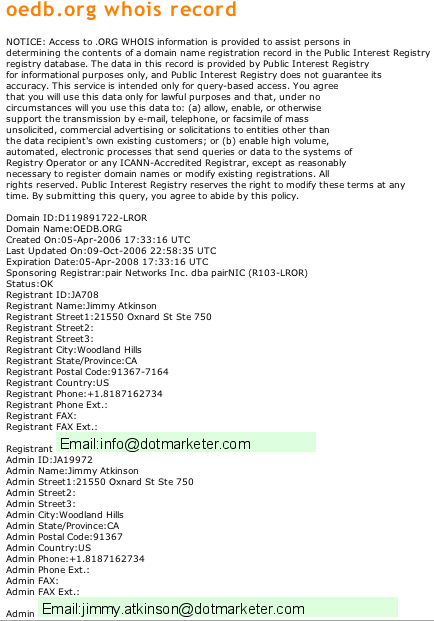
Now off to easywhois.com; I entered the domain: oedb.org. The results:

I zeroed in on:

Created On:05-Apr-2006 17:33:16 UTC
Last Updated On:09-Oct-2006 22:58:35 UTC
Expiration Date:05-Apr-2008 17:33:16 UTC 

as well as the Registrant Name, City, State, Country and the email addresses.

Next a Google search for "Jimmy Atkinson." Some self promotion sites but there could be more than one Jimmy Atkinson in the world. The sixth hit was to the Six Sigma Blog which also appeared on a list of sites sourced back to dotmarketer.com. The fourth and fifth hit were to a recent Stephen Downes post at OLDaily where he gives a positive but reserved review of a "post" by Jimmy Atkinson at OEDb called Hacking Knowledge: 77 Ways to Learn Faster, Deeper, and Better. (I only skimmed the article but it did catch my interest and I plan to go back and read it sometime next week.)

Last stop on this tour was to the Internet Archive to use the Wayback Machine (I searched for http://oedb.org). This showed the url http://oedb.org first went live in August of 2000. It was about the Oahu Economic Development Board (OEDB) in Hawaii. In July of 2002 the site undergoes a major redesign and name change to Enterprise Honolulu which is still active at http://www.enterprisehonolulu.com. The next major change is when the domain switches ownership and becomes the Outdoor Education Database (OEDB) on August 6, 2004. The last record of the domain is April 28, 2005. It is still the url for the Outdoor Education Database. From what I learned above it looks like Jimmy acquired the domain for the Online Education Database (OEDb) in April of this year and went public with it three months ago, in September.

I looked at the top 100 list of education blogs. There are a lot of folks I know there. It's a pretty good list although I'm glad I didn't write it. I really wouldn't know where to begin, or end, such a list.

Jimmy seems to like my blog. I'm gratified that he feels my work belongs in his top 100; but is it "big news" that A Difference has made this Top 100 list? Well, no, not really. It looks like it's just one person's opinion. The site and email made it look like it was a significant accomplishment. I think the Eddies were a much bigger deal.

Why would Jimmy do this? Go to all the trouble to find, organize and link to 100 different edublogs? That's a lot of work! He might just be trying to generate some traffic on his site or he might just want to share his personal favourites list. Either way, there's some opacity here that should be made transparent.

I hope my students are reading this.