#dda27 Book Spine Alchemy Spell

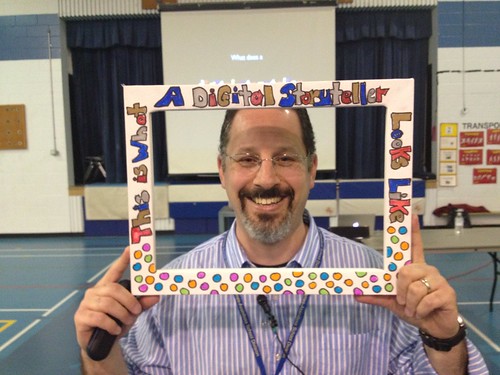
Dig pic

Back to blogging ...
Back to making stuff again ...
Back to sharing ...
If you want to follow me this is what I look like from behind ...

#12kindacts Today I built someone up "behind their back". They'll never know.

Jumping through the Labyrinth of Networked Narratives fearlessly lead by my buddy and lifelong friend Alan Levine aka @cogdog. Naturally, I'm beginning with Day 27 of the Daily Digital Alchemy ...

#dda27 Book Spine Alchemy Spell
In a variation of book spine poetry, see what kind of magic spells you can cast by stacking books and taking a photo of their spines.

And it changed me ... 
These books have changed my thinking in profound ways, or, riffing off an old Van Morrison tune, "And they changed me to my soul ..."
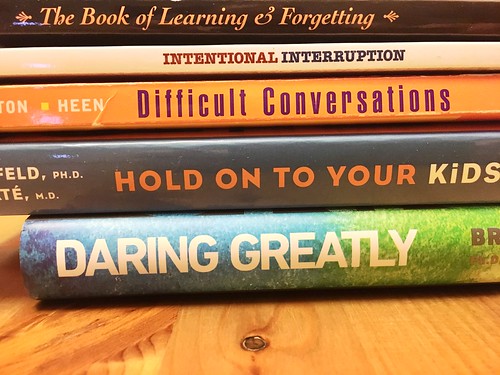
And it changed me ... #netnarr #dda27

You, Your Kids, and Your Phones

A while back I shared some ideas for talking about Digital Citizenship using visual metaphors. It's important to continue these conversations in school amongst educators and with our students. We have to involve parents too.
Digital Citizenship isn't an expression often heard outside of school. The ways in which it's discussed in main stream media are quite different from how it's discussed in schools. Most often the popular press shares sensational negative stories how kids use the internet and their phones to hurt each other.

We have to have open and honest conversations about how things can and have gone wrong and what we can do to make things better in the aftermath of things like cyber bullying, online harassment, or sexting. That said, it's a far more powerful message to talk to kids and parents about how engendering empathy helps us understand each other so we choose not to hurt each other. It's also important to share stories and ideas how our modern mobile technologies empower us to effect positive change in the world around us in ways that weren't possible 10 or 15 years ago.

We have to move beyond stranger danger and scare tactics. Sharing frightening stories (often overstated) does nothing to model positive outcomes or move the conversation to discussions of how to deal with something gone wrong.

Kids need more models of empathy and empowerment. Parents do too.

Below is an interactive "stand alone" presentation I made specifically to start these kind of conversations with parents. Many of the slides are "clickable"; clicking on the centre of a slide will take you to the online article or resource displayed. There are also several short videos embedded throughout. It should take about 20 minutes to work through it all, including the videos. I hope the conversations it starts last much longer.

If you use anything I've shared here let me know how it goes.


photo credit: creative commons licensed (BY) flickr photo by photoloni

From Rap Music to Deep Learning Across the Curriculum


Why is rap artist Eminem considered to be such an impressive lyricist? And how does that help my students learn literature, history, current events, science, or mathematics?

Here's why Eminem is an outstanding lyricist:


So how does that help my students learn literature, history, current events, science, or mathematics?

Would it be fair to say that deep learning in your classroom includes students who:

  • closely read the texts you assign?
  • reflect on what they read while they read?
  • make connections between assigned texts and other sources, including multimedia from across the web?
  • actively participate in class discussions that continue beyond the time and space of the class?
  • get formative feedback from you and their peers; perhaps even from other learners beyond the walls of your classroom?

Genius.com (originally rapgenius.com) started with a passion for sharing how different people understand rap lyrics by adding personal digital annotations. It grew into an effort to collaboratively share and interrogate any web based content using text, images, videos, and links. While it began as an effort of rap lovers to better understand the meaning behind rap lyrics it wasn't long before the community grew to include the artists themselves and expanded into other forms of music, poetry, literature, news, history, law, sports, and any other web based content.

Genius is less of a website destination for people to collaboratively annotate web based text and more of a portable web based tool building a shared understanding of the meaning of any content at all. For example, the animation below shows Lewis Carroll's Jabberwocky annotated and analyzed over time on genius.com. Below that, you'll find the embedded article to which you can contribute your own analysis.


Here's the live embedded page you can add to if you like; click on any of the highlighted text:


A number of educators (K-12 and Higher Ed.) have taken to hacking what was once a venue only for rap lovers and making it a dynamic learning platform called Education Genius.


I like the inclusion of game mechanics such as Achievement, Micro-Leader Boards, Progression Dynamic, and Status baked into the system. (People often confuse "gamification in education" with the simple playing of games. Gamification is really about using the compelling dynamics of game play in a educational setting.)

Genius includes modern novels such as: Area X: The Southern Reach Trilogy by Jeff VanderMeer (who added his own annotations to the discussion), the Seven Ages of Man monologue from Shakespeare's As You Like It, The Great Gatsby by F. Scott Fitzgerald, and  the complete works of Charles Dickens.

There are special genius.com education accounts for educators.

I'd love to see how a math teacher might hack this system to have students engage deeply with mathematics texts. Imagine if you had your students solve and annotate solutions to exam level questions as a review of your course leading up to a test or final exam. What if you then had the class as a whole engage with these student generated mathematical texts in the way people have done with the literature examples shared above? If you're looking for some online examples of this sort of work feel free to start with these wiki examples (Student Created Wiki Solutions Manuals) from my own classes:


Those links to my class wiki solution manuals may be a little dated; if I was doing this today I'd deliberately weave in more of the game mechanics I mentioned above.

You can apply the process described here, and on my class wikis, with pretty much any level of math from at least grade 7 upward.

If you do, let me know how it goes.

photo credit: creative commons licensed (BY) flickr photo by - EMR -

How Much Homework Is Enough?

The short answer is: It depends?


The Council of Ministers of Education Canada started publishing Assessment Matters! in 2013. These are a series of short summaries of specific educational issues that emerge from four different national or international assessment tests:

     • The Pan-Canadian Assessment Program (PCAP)
     • The Programme for International Student Assessment (PISA)
     • The Progress in International Reading Literacy Study (PIRLS)
     • The Trends in International Mathematics and Science Study (TIMSS)

The value of homework for learning is a much debated issue. (See Rethinking Homework by Alfie Kohn and The Case For and Against Homework by Robert J. Marzano and Debra J. Pickering.) Recently, Assessment Matters! published a summary of findings from PCAP, PISA, and PIRLS(pdf) that summarizes what we've learned about how much homework is enough. This is what they learned:

Grade 4 Reading - PIRLS 
It turns out that spending more than 15 minutes a day doing "reading homework" negatively impacts reading achievement for students in grade 4. The blue bars in the graph below show what proportion of students typically do reading homework for various lengths of time. The broken line graph shows the same students reading achievement scores. The report quotes Canadian teachers: "more does not necessarily mean better."


Grade 8 Math - PCAP
Students who don't do any math homework have the poorest results on the PCAP test. After about 30 minutes of homework per week, students experience diminishing gains in terms of their results on the PCAP test.

Numeracy Note 1: Look closely at this graph. The scale goes from 440 to 540. The differences between the bars would appear much smaller if the graph started from 0 on the left and went to 540 on the right. This suggests that while there may be some gains to be had from homework in the middle years those gains may be rather smaller than implied visually by this graph. The same is true for the graph above (it goes from 520 to 570 rather than 0 to 570).


15 year olds & Math - PISA
Again, like grade 8 students on the PCAP test, 15 year olds who do no homework have the poorest achievement scores on the PISA test. And similarly, after about an hour a day homework offers diminishing returns on student achievement scores. With that said these results echo much of the research results on homework: modest gains for older students.


Numeracy Note 2: This graph shares the same issues with the scale represented (it displays values from 470 to 550 rather than 0 to 550) as those above. The left hand scale is measuring PISA test scores. The percentage scale on the right goes from 0 to 70; it measures the percentage of students who do different amounts of homework each day. The scales measure different things. Had the right hand scale started from 0, the right hand percentage scale, also starting from 0, would leave a rather different visual impression on the reader.

This graphs shows the same information using a common scale:


This is the same information again with different relative scales (600 max test score and 100 max percentage) both starting from 0:


These last three graphs represent the same information. They have quite different visual impacts. Go back and take another look at the first graph above; notice anything?

Further Reading
There are many nuances that go into determining the effectiveness of homework. "Having Homework" as opposed to well designed purposeful practice that students can reasonably accomplish independently aren't necessarily the same thing. The Canadian Council on Learning, having done a systematic review of the research on homework concludes: Homework helps, but not always.(pdf)

See also: Homework: What the Research Says(pdf) by Harris Cooper and Rethinking Homework(pdf) by Cathy Vatterott.

Further results from the tests mentioned above are available online: 


How much homework did your teachers assign when you were in school? How much of that homework did you do? How much homework do you typically assign to your students? How much of it do they typically do? How do you think homework best supports student learning?

photo credit: creative commons licensed (BY-NC-ND) flickr photo by MarkGuitarPhoto

Digital Citizenship Using Visual Metaphors

While Digital Citizenship Week has come and gone it's important to keep the conversations going. If you missed Digital Citizenship week it's never too late to get started.
Here's a practical hands on tool kit shared on Craig Bandura's blog he calls The Digital Citizenship Survival Kit. It's an excellent way to use physical prompts and metaphorical thinking to help kids understand how to behave ethically online. While Craig uses this kit with students in kindergarten through Grade 8 it'll work well with students of any age.

I've included Craig's original list of items and a few other suggested by people who commented on his blog. I've also added a few of my own nuances and additional resources for teachers to use with their students.

The Digital Citizenship Survival Kit


Padlock: Padlocks are used to secure the stuff kids keep in their lockers. It's also a reminder to keep your online passwords secure and private to protect your online stuff.

Toothbrush: In the same way you wouldn't share your toothbrush with someone else, don't share your passwords.

House Key: Younger students can be reminded that their passwords are like their house keys; only to be shared with trusted family members like their Mom and Dad.


Permanent Marker: Remember that what you "write" online stays online. Even SnapChats aren't really deleted when you know that apps like SnapHack exist.

Toothpaste: In the same way you can't get toothpaste back in the tube once it's out, you can't always unpublish what you've shared online. Think before you post:


Bar of Soap: Try to keep it "clean" online. You can check your social media footprint using free sites like Reppler; try it now.


Picture of Grandma: It’s not really about only publishing stuff you’d be happy for your grandmother to see; it’s more personal than that:


Coffee Filter: Don’t believe everything you find online, apply a critical thinking filter to everything you see. For schools, remember the best internet filters are the one’s we help students install in their own heads.


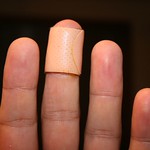
Bandaid: Don’t use words that hurt; use words that heal. Do One Good Thing. Better yet, have your kids discuss what one good thing they might do and have them share it like the kids in the videos below. Start planning now for Safer Internet Day; the second Tuesday in February. This year that will be 10 Feb 2015. (The first video in the playlist below might be a good conversation starter around the idea of doing one good thing.)


There are many more good ideas for visual metaphors in Craig’s update to his original blog post: The "New and Improved" Digital Citizenship Survival Kit. (The crumpled paper is my favourite.)

Let me know how it goes if you use any of these ideas in your classes.

photo credits: creative commons licensed (BY-NC-SA) flickr photo by Dan Callahan, creative commons licensed (BY-NC-SA) flickr photo by dkuropatwa, creative commons licensed (BY) flickr photo by Sh4rp_i, creative commons licensed (BY-NC-SA) flickr photo by Dave Lanovaz, creative commons licensed (BY) flickr photo by walknboston, creative commons licensed (BY-NC-ND) flickr photo by LuluP, creative commons licensed (BY-NC-SA) flickr photo by gorgeoux, creative commons licensed (BY) flickr photo by mauren veras, creative commons licensed (BY-NC-SA) flickr photo by Monimix, creative commons licensed (BY-NC-SA) flickr photo by tonx, creative commons licensed (BY-NC-ND) flickr photo by jugbo

Assessment Rocks and Sucks!

I recently facilitated a conversation with new teachers on Assessment. I very much wanted to model what active learning can look like in the classroom and I simply refuse to just talk at people for an hour without involving them in the conversation in some way (as you can tell from slide 2 below).

The format was a riff on an EdCamp classic activity called Things That Suck.

Clear the tables and chairs away. Everyone stands up in the middle of the room, me at the front. My right hand is the "Rocks" side; people stand there if they agree with the statement on the slide. They stand on my left if they disagree; the "Sucks" side. They can also stand anywhere in the middle and change their mind at any time by "voting with their feet."

Each slide is followed by a 5 minute timer. Once the timer starts anyone can call out (I facilitate this part a little bit, making sure people get a chance to speak and be heard) and say why they've chosen to stand where they are. It's always fascinating to watch people walk across the room while listening to someone else because they've changed their mind.

Pro Tip: Get a "collaborator" to play devil's advocate; preferably one of the participants rather than someone seen as a leader. Very Machiavellian, but it works. And it's fun. ;-)


Feel free to use these slides or just replicate the format to foster some interesting conversations with folks where you are. Let me know how it goes.

Are Laptops Really Bad For Learning?

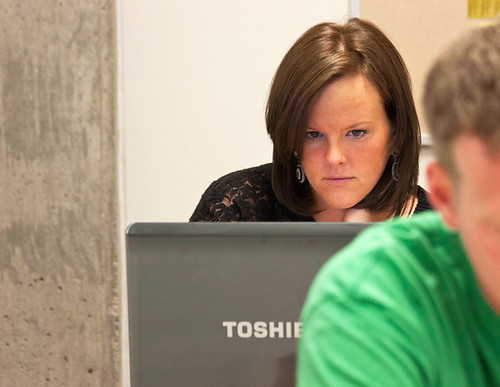
A study was recently published in the Journal of Psychological Science and subsequently reported on in The Atlantic, Scientific American, The Association for Psychological Science, several educational blogs, The Washington Post, and elsewhere online. The study is titled: The Pen Is Mightier Than the Keyboard: Advantages of Longhand Over Laptop Note Taking. The general consensus seems to be that people learn more effectively when taking notes using pen and paper rather than laptops.

THE EXPERIMENTS
Experiment 1
• Watch 5 TED Talks on YouTube.
• Take notes with either a laptop or pen and paper.
• Afterwards participate in distracting activities in another room for 30 minutes.
• Take a quiz on the content of the TED Talks.

Pen and paper note takers did slightly better at factual recall, significantly better on conceptual questions. The laptop note takers took more notes (they transcribed more content) than those using pen and paper (they summarized & synthesized more content).

The research on note-taking suggests "more notes" is a sign of more effective note-taking, however, verbatim transcription is a sign of shallow cognitive processing compared to summarizing and synthesizing.

Experiment 2
The same set up as Experiment 1 with one change. Laptop note-takers were alerted to the shallow cognitive processing associated with transcription style note-taking and told to avoid it. They were also told to take notes as they would in a classroom.

The results were the same: more notes taken by people using laptops, pen and paper note-takers did better on the follow up quiz.

Experiment 3
Again, the same set up. And again, with one difference. Since people typically review their notes before taking a test students were given 10 minutes to review their notes before taking the follow up quiz.

Again, more notes were taken by people using laptops. Pen and paper note-takers did better on the follow up quiz.

THE CONCLUSIONS

Many people concluded from this study that students shouldn't take notes with a laptop; handwriting is better. Mueller and Oppenheimer, the authors of the study, concluded:
Although more notes are beneficial, at least to a point, 'if the notes are taken indiscriminately or by mindlessly transcribing content, as is more likely the case on a laptop' than when notes are taken longhand, the benefit disappears. Indeed, synthesizing and summarizing content rather than verbatim transcription can serve as a desirable difficulty toward improved educational outcomes (e.g., Diemand-Yauman, Oppenheimer, & Vaughan, 2011; Richland, Bjork, Finley, & Linn, 2005). For that reason, laptop use in classrooms should be viewed with a healthy dose of caution; despite their growing popularity, 'laptops may be doing more harm in classrooms than good.' (p. 1166)

IS THAT WHAT THE RESEARCH SAYS?
In short, no.

The study does show that using a laptop is highly correlated with verbatim note-taking; we know that's not an effective way to take notes as opposed to summarizing and synthesizing.

John Jones, Assistant Professor of Professional Writing and Editing at West Virginia University, also points out a problem with the instructions given to students in the second experiment. Namely, that students were told to take notes as they typically would in class when using a laptop. The warning against verbatim note-taking may have been ignored in the face of the students falling back on what they typically would do with their laptops. It's unlikely their note-taking habits would have been changed by a brief verbal warning in an unfamiliar learning situation.

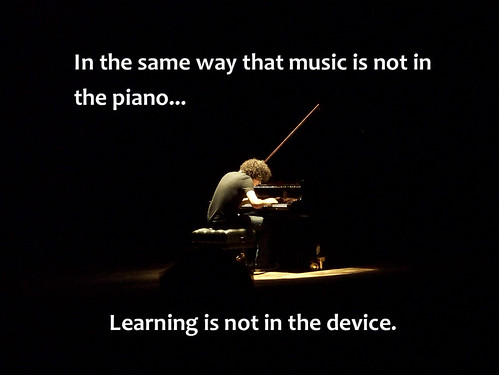
LEARNING ISN'T IN THE DEVICE
In the same way learning to ride a bike and learning to drive a car require different learning experiences using different learning tools also requires different learning experiences. Students don't automatically know how to take notes; it's a learned skill, one we have to teach.

In the words of John Jones:

I am not criticizing Mueller and Oppenheimer's research, only the implications they draw from it. The correlation between laptop use and verbatim note taking is incredibly useful information for it allows educators to address how students use their tools. It certainly does not suggest that laptops are "harm[ful]" or should be restricted. The "pen" is not "mightier than the keyboard."

Moreover, we have to ask, is taking notes in a lecture hall what we mean by "learning"? Surely what we mean by "learning" is a far richer experience than that.


Cathy N. Davidson, Professor of Interdisciplinary Studies at Duke University, has more to say about this study as well. In particular, she says people are asking the wrong question.

What do you think? What do you mean by "learning"?


Cross posted at the Canadian K12 Blueprint.

photo credits: creative commons licensed (BY-NC-SA) flickr photo by Tulane Publications, creative commons licensed (BY-NC-ND) flickr photo by Newman University , creative commons licensed (BY-NC-SA) flickr photo by ransomtech

5 Rules of Thumb for Teaching HOTS

What are some concrete and powerful pedagogical approaches you can leverage in a 1-to-1 or BYOD teaching environment? What sort of practices shift the focus of teaching and learning from Lower Order Thinking Skills (LOTS) to Higher Order Thinking Skills (HOTS)?

That might be a million dollar question, with many answers. Nothing works all the time, but everything works sometimes; successful learning is largely context dependent. The real question we need to ask is: "What works best in my context'?"

The slide deck below illustrates five concrete teaching practices that may be helpful in answering these questions. They grew out of several workshops I've lead with teachers discussing emerging practices in BYOD classrooms for encouraging teaching HOTS. It may be difficult to hit on all five ideas in every class you teach, and there will always be a place in our classrooms for teaching LOTS too. Nonetheless, having these rules of thumb knocking around in the back of your head can help create learning experiences for your students focused on HOTS.


Personalize Tasks to Students' Life Experiences
This is sometimes described as "personalized learning". Both the Alberta Initiative for School Improvement (AISI) and the British Columbia Education Plan discuss and share resources for personalizing learning.

Publish
When students know their work is being seen by an audience beyond the classroom it encourages them the "up their game" a bit and do better work.


Be aware that there are two sides to this coin; one positive (Social Facilitation) and one negative (Social Inhibition).

Collaborate on Group Worthy Tasks
Find ways to have your students collaborate on group worthy tasks. A group worthy task has two seemingly contradictory components: It both requires interdependence amongst students and individual accountability.

Carefully constructed group learning activities can foster students' academic and social growth and help close the achievement gap. (pdf)

Feedback
Giving effective feedback is hard. Dylan Wiliam says: "Feedback should cause thinking."


When you orchestrate feedback for your students from sources outside your classroom you also weave in the effects of many of the other rules of thumb mentioned above.

Teach Something
Teaching something is one of the most powerful ways to learn that something. As teachers, we all know that "knowing a thing" and "teaching a thing" is not the same thing. Find ways for your students to teach what  they've learned from you to others. If they do that online they are also making a contribution to the global knowledge commons.

Have you used any of these ideas in your own classroom? What was that like? Leave me a comment and let me know.

Digital Citizenship ≠ Digital Ethics


Maybe this is just a personal pet peeve of mine but there's a difference between Digital Ethics (ethical and responsible use and behaviour) and Digital Citizenship. The later is really about doing the things a good citizen does: participate in the governance of the community to which you belong, make a meaningful contribution to the global knowledge commons, leave things a little better than how you found them. i.e. participate in the community in ways that improve it.

It seems to me people often confuse ethics with citizenship. Both are important, they may even overlap in some places, but they're not the same thing.

cc licensed ( BY NC SA ) flickr photo shared by mars_discovery_district

"60 000 times faster than text" ... Really?

I just got an email from Alan Levine. He's sniffing around for the origin of the quote many folks have often used, myself included, that we process visual information 60 000 times faster than text.


Here's what Alan said:

I need your help. I have found an assertion repeated on thousands of web sites, and repeated so often that it is cited as a fact, yet I have tried and tried and have been unable to locate the actual source of this claim:
Research at 3M Corporation concluded that we process visuals 60000 times faster than text.

In the interest of dogged pursuit, information literacy, and all that we value as scholarship (okay I am laying it on)- can you help me find the answer? Or spread to someone who can?


Here's what I found ...

I started with the search engine millionshort.com by eliminating the first million hits from Google I circumvented the lions share of SEO (Search Engine Optimized) sites and took a first stab at the deeper web.


The 6th & 7th link struck me as worth following, the 7th link included a citation “The Power of Color in Presentations:”. (http://www.sspweb.com/SSP/visual_lit/VisualLitOnline.pdf) I thought the inclusion of a colon here was odd, probably someone doing a quick "cut & paste". I followed the link to a middle school student's paper. In the bibliography she cites a presentation by Ian Jukes. (Not the one I've included in that link. Its a pdf; page 8.) I first heard the "60 000 times faster than text" claim from him several years back in St. Louis at a workshop for administrators.

One more comment about that student's paper, look at where it's hosted; www.sspweb.com. Looks like a software solutions company. Why would a Middle School kid's paper be there? I did a little digging (go look at their About page). I suspect it's likely her teacher's website.

The link to the Ian Jukes reference is dead, I tried several ways of getting at it but didn't work too hard as I really wanted another source although he might have included some bibliographical info in there somewhere I suppose.

Another search and I found the 3M web page for "The Power of Color in Presentations":

http://www.3rd-force.org/meetingnetwork/readingroom/meetingguide_power_color.html

There is no mention of the "60 000 times faster than text" research.

I did another regular Google Search for:

3m “The Power of Color in Presentations”
(quotes included; I removed the colon)

I found a link to a Google Books search:


In the book "They Snooze You Lose" by Lynell Burmark she cites the source as:

http://www.presentations.com/deliver/audience/1998/05/13_fl_psy_01.html

I looked up the link, which was dead, but the date (May 1998) struck me.

A custom Google Search for dates between 1 Jan 1900 and 31 Dec 1998 lead me to what I thought was the original presentation at 3M where I found this quote (below) in the transcript of a presentation given by Jenn Manalo, Sr. Product Specialist, 3M Corp. This talk was given at St. Louis College Valenzuela on 31 Aug 1998 (I used my browsers "find" command to search for the number 60 and five clicks of "next").

"Humans can process an outstanding amount of visual information. Actually, we can process at 60,000 times faster than text."


Looking up that specific quote using each of the different options at millionshort or a regular Google search returns one result; that very same web page.

Now, let's look up Jenn Manalo, Sr. Product Specialist, 3M Corp.

No fruitful results from pipl.com or linkedin.com or anywhere really. I found several Jenn Manalos in the Philippines. I suspect Jenn is Filipino because she uses two Tagalog words in her talk "matandang mayamang" (old rich) and the url from the archive of her talk has a Philippines root (.ph). Also, St. Louis College is in Valenzuela, Philippines. None of the LinkedIn profiles I found have a Jenn Manalo ever working at 3M.

Lastly I used the "site" command and Googled:

site:http://www.3m.com Jenn Manalo

Nothing.

So it seems Jenn said it; maybe even said it first. (Her talk is dated 31 Aug 1998 and the date embedded in the link from the citation in Lynell Burmark's book points to May 1998 ... there's more work to be done here.) She said "research shows …" a number of times in her archived talk but did not say so for the "60 000 times faster than text" fact; although it is in quotation marks as though she's quoting another source. (Then again, it might be the redactor quoting Jenn.) She may have worked for 3M in the late 1990's and she gave a talk on effective presentations at St. Louis College in Valenzuela, Philippines.

Learning Pyramid
Learning Pyramid (Photo credit: dkuropatwa)
It's worth noting that Jenn alluded to someone else saying the "60 000 times" fact and, although she may have been employed by 3M, she didn't say the research was done by 3M.

All this reminds me of the Learning Pyramid hoax and another time I was "awarded" a Top 100? blog.

Good luck with the search Alan. I can't wait to learn what more you find. ;-)


UPDATE: Getting Closer

I realized I hadn't limited my original Google Search to the 1 Jan 1900 - 31 Dec 1998 time frame. So I went back and did that.

First hit was this pdf: Read 180 Aligned to No Child Left Behind hosted at scholastic.com (a subsidiary of the McGraw Hill publishing company). The research collected here is in support of their Read 180 literacy product. Direct from the pdf:

Media Researchers have found that humans process visual information 60,000 times faster than text, and visual aids can improve learning by up to 400 percent (Burmark, 2004).

I looked into Burmark … actually, I had already started that above. She's the author of You Snooze You Lose I mentioned previously. She apparently mentioned this same "fact" in her 2004 Book, Visual Literacy: Learn to See, See to Learn. In this pdf advertisement for the book she writes: "According to research from 3M Corporation, we process visuals 60,000 times faster than text."

We've already been down that road.

I'm not closer to the source of the research; I'm closer to saying it's an academic legend of the same sort as the Learning Pyramid hoax.

UPDATE: 14 July 2012

Still scratching away at this. I came across the "Pictorial Superiority Effect." These are the results of my digging around:

"Combining pictures with print or audio generally maximizes learning."

Still nothing about "60 000 times faster than text".

Linked text is different

Reading (318/365)
cc licensed (BY-NC) flickr photo by Jack Amick
A few years back my friend Bud Hunt published an unusual post on his blog; it was titled Going South. In just a few short sentences he shared that he'd be spending a week visiting his grandfather's garden. "As best as I can determine, the first reference on the Internet to my grandfather, a man that I know far too little about, is this one." he wrote. There was one link in the entire post; the words "this one". You can tell from the comments, not every reader followed the link.

I was talking with a couple of English Language Arts teachers today. They're planning to have their classes do most of their writing online this semester. We were talking about how they might use a Mother Blog model to do that. They'll use Google Reader to monitor the community; subscribing to both the posts and  comments of their students' blogs.

I wanted the two teachers I was talking with understand how to help their students learn to read and write hyperlinked text effectively. I shared with them the story of Bud's "Going South" blog post. It's a poignant lesson in reading and writing linked text. (In the privacy of my own thoughts: This will also be a nice memorial to Bud's granddad. In a way, he'll teach and touch the lives of generations beyond his immediate family.)

A Better Metaphor for Life Long Learning
In his book, Everything Is Miscellaneous, David Weinberger talks about the difference between writing on paper and writing hyperlinked text. Paper has physical limitations that digital text doesn't. It starts and ends. It's only so wide and so long. A paper book can only contain so much content. Even if it's one of many volumes in a larger work.

Have you ever started reading an article online, say in Wikipedia, clicked a link, then another? And another. Only to find yourself two hours later having explored a web of ideas unique to your personal interests along the way. Eventually you stop. Not because you're "finished" but because life imposes other demands on your time.

Digital text is different. It's a much better metaphor for life long learning. And you can't write linked text if you aren't reading. Lots. (It's taken me years of reading to write this blog post.)

New Media, New Process
Not too long ago Dean published a post about writing hyperlinked text. He had collected a number of comments in a storify archive and reshared a video Will had made about his writing process. (Think that through as a writing process.) Watch:


This sort of process is another thing I shared with the teachers I was talking with:


  • Using a mind mapping tool, like mindmeister, that includes hyperlinks is different.
  • Clipping ideas contained in text, images and video using a tool like Evernote, which allows you to create web pages & hyperlinks is different.
  • Writing by stitching your ideas together from hyperlinked sources is different.
  • Reading that text is different too. It matters where you publish it, online or off. Different media (paper or digital) carry different messages. 


I'm fascinated to see the student writing that emerges from this semester.

I'm also curious; is there anything different about how you teach reading and writing digital text? Any advice for us?


UPDATE 20 Feb 2012
Check out Bud's thought provoking digital writing workshop (a network of Google Docs): 
Reading 1.0 - How Digital Changes Nothing. And Everything. Is All.

Too Big To Know #edbookclub

Too Big To Know by David WeinbergerImage by dkuropatwaHow'd you like to know "how our concept of knowledge is changing in the age of the Net"? (John Seely Brown quoted from the dust jacket)


Since I first heard David Weinberger say: "The smartest person in the room is: The Room!" I've repeated it often. I've seen it in action. In his new book Too Big To Know he fills in a few more details about this. The room is "smartest" as a function of the networked connections between all the people in it, and out of it, via the internet. I hear echoes of George Seimens and Stephen Downes in that.


Anyway, the book was published on 3 January 2012 and I just got my copy of it today. In the last 10 days or so the idea of an #edbookclub flared up on twitter. So, we're going to do that. We begin this Friday. We've even got a timeline and a list of people reading together. The conversations have beginning times, to help us all stay on track, but they don't have ending times. So really, join in any time you like.


#edbookclub originally grew out of a conversation between Ben Hazzard and Kelly Power. They describe it:


What is it? #EdBookClub emerged from a discussion between educators (@kellypower and @benhazzard) about how using Twitter could encourage professional dialogue.  It will be a discussion about a common book or article, that is voted on via a TwitPoll, by educators and people interested in applying the book's content in an education setting. 
Why? The purpose of this Twitter discussion is to engage in an informed discussion on Twitter that also provides a purpose and audience for educator tweets.  This was informed by #educhat when the organizers in 2008/2009 began posting articles and other documents to heighten the conversation 
How?
  • Participate: 
  • Read the book or article with us (or listen via the audio version).  Follow the #EdBookClub 'hashtag' on Twitter to find out new information.  Then send messages via Twitter with the #EdBookClub 'hashtag' to offer your ideas, questions, and comments.
  • Respond to #EdBookClub tweets to extend, clarify or question to enhance our collective learning
  • Follow along: Read all the #EdBookClub tweets by following that 'hashtag' 


If you'd like to join us message me on twitter @dkuropatwa and let me know. Get a copy of the book; it's only available in either hardcover or kindle format right now. As you read, tweet reflections and quotes from the book that strike you. Use and follow the hashtags #edbookclub and #2b2k. There's already been some talk about chatting in realtime in a Google+ Hangout or maybe in an eluminate room. 


Anyone want to take turns building a storify each week?

The Difference Between Curriculum and Pedagogy

There's a difference between curriculum and pedagogy. Curriculum is all about what we teach. Pedagogy is about how we teach it.


There's also a difference between knowing how to do something and understanding what you're doing. In mathematics there are all kinds of "how-to", or computation skills, that kids learn and promptly forget right after the test; sometimes they forget before the test. The thing is though, it's difficult to forget something once you understand it.


Seven Principles of Learning by dkuropatwa, on Flickr

Creative Commons Attribution-Noncommercial-Share Alike 2.0 Generic License  by  dkuropatwa 


A few weeks ago I was part of a panel on the Richard Cloutier Reports show on CJOB radio here in Winnipeg. There were four of us: myself, Paul Olson (President of the Manitoba Teacher's Society), Robert Craigen (Associate Professor of Mathematics, University of Manitoba) and Anna Stokke (Associate Professor of Mathematics, University of Winnipeg). Robert and Anna are one-half of the group behind the wisemath blog.


There are some things we agree on:
  • All kids can and should learn basic computation skills (how to add, subtract, multiply and divide).
  • It's important for kids to understand what they're doing, not just to be able to perform by rote.
  • Manitoba's recent poor performance on the Pan-Canadian Assessment Programme test is not good news and we have some work to do in mathematics in Manitoba.
  • We'd like to see Manitoba place at the top of future national and international tests of this sort.


Understanding the concept by dkuropatwa, on Flickr

Creative Commons Attribution-Noncommercial-Share Alike 2.0 Generic License  by  dkuropatwa 


Some things we disagree on. I believe:
  • Learning with understanding should precede the learning of rote algorithms in mathematics.
  • To say Manitoba has placed 10th out of 11 provinces and territories in the 2010 PCAP test is a gross oversimplification of the the data represented on page 24 of the report (pdf). (Those confidence intervals are important. A repeat of the same test would likely have Manitoba place somewhere between 6th and 11th place. This isn't good news, but it's a little more nuanced than "10 out of 11". People knowledgeable about mathematics should be helping the public understand these nuances and promote informed discussion.)
So the crux of our differences are two-fold:


(1) I believe Robert and Anna conflate curriculum and pedagogy and are reading the Manitoba Curriculum documents as pedagogical texts when they were never intended to be read that way. Curriculum tells us "what" to teach, not "how" to teach.


(2) Robert and Anna believe the teaching of algorithms should be student's entry point to learning the basic operations (+, -, x, ÷). I believe the algorithms should be closer to the end-game of learning the basic operations.


John Scammel blogged about his take on the views expressed on Robert and Anna's blog. John points out in the comments the clear distinction the wisemath blog draws between Mathematicians and Mathematics Educators and the populations we teach. In K-12 classrooms we teach all students. The student body in University is different. Students taking math at University want to be there. That's not true of many students in the K-12 sector; the challenges are quite different.


On further reflection, there's a third difference: public (and private) debate should be open and sidestep insult.


The wisemath site seems to reject any comments that debate the blogger's views.


What I've read in the comments on John's blog and on Anna's blog (The last sentence of the last paragraph was recently edited; it used to say all future mathematics education research has no merit as a result of the issues Anna took with the article she blogged about. I regard this edit as a positive evolution in her thinking.) seems to hold K-12 teachers in a disdainful light.


Here's the audio from the CJOB panel we sat on together. It was a 2 hour broadcast, without commercials it's about 58 min. I took out the commercials. We talked about much more than was broadcast in the moments we were "off air". That was also an interesting conversation; unfortunately we didn't capture it. Next time I'll bring along my mp3 recorder. ;-)


Download (53.2 MB)


How would you plan a reunion?

How would you plan a reunion with a bunch of people you're terribly fond of, many of whom you've never met face-to-face, who you touch base with only occasionally and live in places scattered across the globe?

A few years back I lead a group of about 120 teachers in a year long immersive professional development experience around leveraging modern technologies to foster deep student learning. This was for Will & Sheryl's Powerful Learning Practice in their 2nd year of operation.

We did some cool stuff together. Stuff like this game of Presentation Tennis:


That grew grew out of a Digital Field Trip we did into Flickr. Here's the group where we shared our pictures:


Flickr was a great introduction to all sorts of ideas: social networking, learning through play, tagging, visual thinking, rss, collaborative learning, portable content, and more. Most importantly it was a way for us to connect personally. We saw where and how we lived and worked. We saw summer while some of were in the middle of winter. We saw little glimpses of each other's lives while we learned and played together. Bonds began to form.

Cary was looking through our photo pool when she tweeted:


So was born this little online reunion. We'll try to share a photo-a-day for as long as we can make it. If it goes all year great. If not that's good too. No rules. If you miss a day no problem; just pick it up again the next day.

We'll share our pics in our old flickr group and if you weren't part of the original group feel free to jump in nonetheless. Let's all tag our pictures: "intplpreunion12". They'll aggregate below ...


I plan to also add my pics to the 2012/366photos group.

Narrative Matters

Last night a group of Manitoban educators got together to talk about teaching and learning and how that learning takes flight when we take advantage of new opportunities offered by technology.

The evening was framed around having the six Manitobans who participated this summer in something called Unplugd, talk about this uniquely Canadian educational summit: 36 of us wrote a book in a weekend.


Anyone who's spoken to me since I got back from Unplugd knows what a transformational event it was for me and that I've really struggled with figuring out how to share what happened to me in a remote corner of Algonquin Park in North Eastern Ontario; a place entirely off the grid: they have no internet and the electricity and plumbing is powered entirely by the sun. The Northern Edge is a beautiful location.

I couldn't attend the event last night so my friend and colleague Andy McKiel asked me if I'd make a short video to share what I learned and what Unplugd meant to me. It's called Narrative Matters, a double entendre: stories matter and it's important to understand how to use storytelling to make ideas sticky. Here's what I made:

Ed. Note: I should have mentioned that The Northern Edge, where we stayed during Unplugd, is 23 km east of the small town of South River. In the video you'll see a brief picture of the South River train station where we disembarked. "The coat" is hanging on display inside that small building.


You can download the book we wrote (pdf or ePub), please do. Then share it.

I facilitated the team that wrote the first chapter: The Change We Need. Andy, Chris, Jaclyn, Lorna and Shelley made my job easy; they're some of the finest people I know.

I shared a story that motivated my written contribution to the book. Many people did, you can find the archive of all those shared stories in the Unplugd video archive. Here's mine as well as my written piece for the book.


You Matter
You matter because you can change the face of teaching and learning in your school. All you have to do is change the world - a little bit at a time. 

No teacher before you has ever taught children quite the way you do. No one ever will again.


The world needs to know what you’re doing. How you go about sharing your passion, your excitement, your enthusiasm for learning with the students in your classroom every day.


You make a difference in the world in the way you do this.


What you want for your students is for them to excel beyond your own expertise in all they learn from you.


It’s the dream of every teacher: to have your students become more knowledgeable, more capable, more competent than you.


It’s a measure of success.


Essentially you share your spark with them.


What we most want is to pass on that spark, this other centred attitude, an attitude towards the world that says: You Matter!


Adopting the attitude: “You Matter”, making people other than ourselves important and finding ways to make them more awesome, in the end, makes each of us a little more awesome. It creates the change we need in the world.


Let's pass that on to our students so they know they matter and understand their job is to make everyone they meet a little more awesome. When they’ve internalized what they’ve learned from us and brought it to another level: that’s success.


No one will ever see the world through the eyes of our students again. No one ever has, throughout the entire history of humanity. They have a unique contribution to make. We help them understand this is also true for everyone they meet.


Imagine a Canada, a world, where every politician, every trades-person, every professional, every store clerk tackled the world in this way? They’re all sitting in your classroom. Learning from you. Teach us too. Share what you know. Share how you know. Share what you learn. We need you too. You matter.