How Flickr Threw a Switch In My Head

Last year, one of the people in my aggregator, D'Arcy Norman, published a video to share the results of his year long experiment: he took a picture every day for a year and published it to his flickr account. He called the experiment 365 Photos. Actually, an entire community has grown up around this idea on flickr; it wasn't D'Arcy's idea originally, there are over 1200 "365 Days" groups. I don't know who started this originally but it seems like a natural extension of publicly sharing your photos.

D'Arcy said a switch got thrown in his head. Watch his video of the results; as you watch you'll get a sense of what his year was like, when and where he went on vacation, his love for his son, the things he finds interesting, but pay particular attention to how he uses perspective, how sets up his "shots", and the things in his world he notices:

As the new year rang in for 2008 several other people in my aggregator decided to join D'Arcy in his new experiment: 366 Photos (2008 is a leap year). After several weeks many started writing about how their visual perception changed as a result of doing this. They started noticing things they hadn't before, the quality of the photos they took (of things, family, friends, events, etc.) improved dramatically, and a switch in their heads flickred.
I came late to this party for a number of reasons, not the least of which is that the "every day for a year" commitment intimidates me. So, in March I started my own experiment: 31 Days.

There's a bit of folk wisdom that says it variously takes 21 or 28 days to create (or break) a habit. (15 minutes a day every day. If you miss a day just keep going until you get to 21 — or 28 — days in a row.) I've been able to find no verifiable research to back this up so make of it what you will. In any case, I did find that my 31 Days experiment lead to a change in the way I see the world and use visual imagery in my teaching.

Now, this part wasn't planned, but as I've used flickr more and more I've become more and more interested in taking "interesting" pictures.

As a math teacher I was fascinated to discover that photographers have long known of and used a mathematical definition for beauty. It's based on the number φ, phi (one H of a lot cooler than π, as my students say), which it turns out is embedded in the the natural world in all sorts of ways including the various dimensions of our own bodies. I digress, that's a post for another time. ;-)

I stumbled upon an online photography course over at morgueFile.com. I've only read through Lesson 1: Composition And Impact - It's A Beautiful Photograph, But Do You Know WHY It's Beautiful?. It had a significant impact on how I take pictures and view the world. That was almost a year ago. I'm about ready to move on to Lesson 2: Aperture And Shutter Speed - How They Work Together.

Here's how I did my 31 Days experiment:

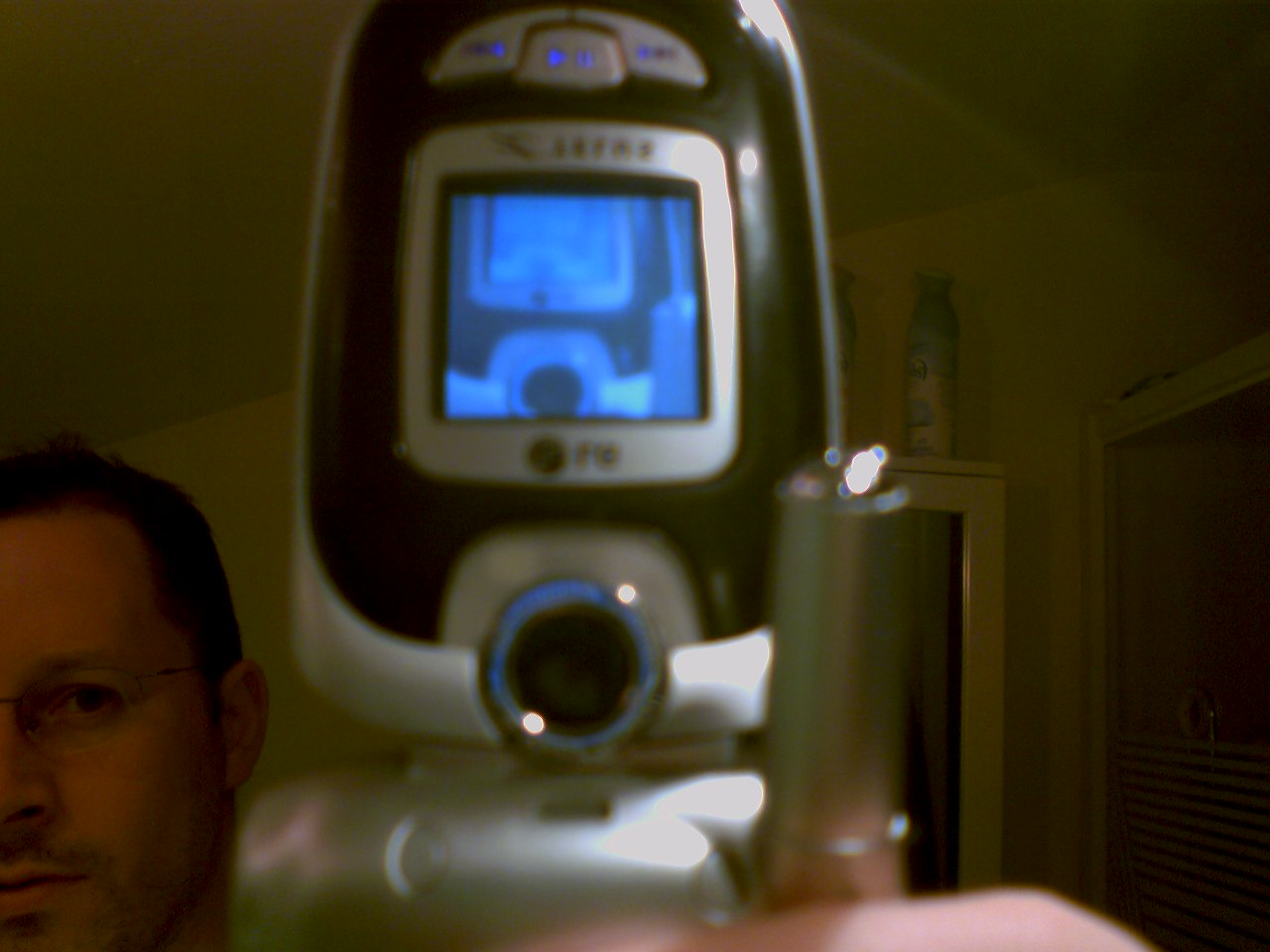
 » All pictures were taken with my cell phone. (Because it's always there, and it's easy.)

 » All pictures were uploaded to flickr (almost) daily. (You can send directly from your phone if you like.)

 » All pictures were tagged with a unique tag for the experiment. i.e. 31Days.

 » All pictures were aggregated on my blog using a slideshow tool, SlideFlickr.com (also allows you to embed music).

 » I took at least one picture every day. (Some days I took more and picked the one liked best.)

You might wonder: Why all this photography stuff from a math teacher? Well, the short answer is that I wanted to model what I asked my students to do — check out the flickr assignment I designed.

The long answer is: It has enriched my life. I used to leave taking pictures to others; my wife or mother-in-law. Now I take more pictures than anyone, and the skills I've developed have lead to some striking pictures of my kids (sorry, we don't publish publics pics of our kids online ... yet). More than that, it has effected the way I read to learn. I recently finished reading John Dewey's Experience and Education. I decided, as a mnemonic and a way to help me move everything I read into long term memory swiftly, I would mentally construct an image that summarizes the content of each chapter. I hope to publish it as a slidecast (slideshow + podcast) on Slideshare in the near future. I know that little book really well as a result of doing this. Creating the slidecast will really embed it in my brain.

Anyway, I think I'm ready to try this experiment again in October. October in Winnipeg starts with colourful leaves on the trees and ends with snow on the ground. This is going to be fun!

Photo Credits:
Me and my Cell by flickr user dkuropatwa
Vitruvian Genesis by flickr user karlequin

Promise, Tool, Bargain

My main interest in teaching and learning on the web centers around exploring the effective use of social media to deepen our pedagogy and our students learning.

In Clay Shirky's recent book, Here Comes Everybody, he closes by saying that there are three "rules" behind the effective use of any social tool: it "relies on a successful fusion of a plausible promise, an effective tool, and an acceptable bargain with the [students]".

The promise is about why would you use a certain tool. i.e. begin by asking yourself, what do you want to accomplish with your students? What do you want them to learn?

The tool is about answering the question: how do you want them to learn it?

The bargain, in Clay's words, "sets the rules of the road: if you are interested in the promise and adopt the tools, what can you (the students) expect and what will be expected of you?"

This is not a recipe for success. It's more of a framework to pin your thinking on. There are infinite paths to any goal; every teacher and student may start and end a course at the same place but the path they follow to get there is unique to each individual.

These three ideas can serve as a framework to guide our thinking as we try to answer the question: So, exactly what am I going to do differently with all this stuff in class tomorrow?

What do you think? Is this a helpful framework for thinking about using social media in the classroom?

The Global Learners Workshops

I just stumbled upon these videos on google video. They are from a 2 day series of workshops I did last summer for the Global Learners of Adams County School District #14 in Commerce City, Colorado. I knew that Joe Miller had recorded my presentations, I've only just now discovered them. Thanks for sharing this Joe!

While some of my thinking and the assignments I give my students have evolved since then, it's still a pretty good overview of how I work with my students and how I think about designing learning experiences and assessments for them. Each video is about an hour long.

Part 1 of 5: Tear Down The Walls (Day 1, August 9, 2007)


Part 2 of 5: Learning The Guitar (Day 1, August 9, 2007)


Part 3 of 5: Whiplash! (Day 1, August 9, 2007)


Part 4 of 5: What Can I Do Now That I Couldn't Do Before? (Day 2, August 10, 2007)


Part 5 of 5: Developing Expert Voices (Day 2, August 10, 2007)

The Buzz Was About Pedagogy

I was at Alan November's Building Learning Communities conference in Boston from July 15 to 18. This was the third year I was there and it was the best yet because the buzz was different.

Last year I left the conference hearing everyone saying things like:

» I have to learn flickr
» I have to learn wikis
» I have to learn blogs
» I have to learn [insert social media tool du jour]

This year the buzz was much more about pedagogy. The talk in the halls sounded like:

» I can use [this] to teach [that]
» I can see how much easier it would be for my students to understand if I used ...
» My students are going to LOVE learning this way!

I hope that sentiment was captured in the last minute reflection a number of us did together shared via Ustream:

Live Streaming by Ustream.TV

I captured some of the Ustream chat here.

Of course the best part of any conference is the people. I reconnected with old friends, met several "old friends" face to face for the first time, and met some people for the first time. Together, they made the conference feel like going to summer camp. ;-)

The three Keynote presenters (Ewan Mcintosh, John Davitt, and Dr. Pedro Noguera gave talks that dovetailed nicely together with a very strong focus on teaching and learning. They hadn't planned it that way but it seemed as though the three of them had collaborated to deliver a unified message. (If you want to listen to their talks Bob Sprankle has some of the best BLC08 coverage on the net over on his blog.)

I gave three presentations. One was an update from another I gave last year (What Can I Do Now That I Couldn't Do Before), the second (A Day In The Life) was a major revamp of one I did for Alec Couros' and Dean Shareski's graduate classes earlier this year. I worked hard to refine the ideas and practices I was sharing and tie them much more tightly to research on teaching and learning. The third (Everything New is Old Again: living and teaching in accelerating times) Clarence and I did together. This was the first time we had ever presented collaboratively. (This particular collaboration involved skype, google presentations, flickr, and Starbucks; a story unto itself really. ;-))

Mobile phones appear to be coming into their own as a learning tool this year. I tried something different using the photo capabilities of participants' mobiles and flickr. While in session I shared my private "publish directly to my flickr account" email address. I asked everyone to take pictures with their phones and email to the address I gave them (I've since changed the address). My account was set up to tag the photos automatically BLC08. Meanwhile, I had a wiki where I archived all my presentation resources. On a page in the wiki I embedded a slideshow I had created using Slideflickr. Slideflickr allows you to link music located somewhere online to play automatically while the slides are playing. I used Skreemr.com and Jamendo to find the music I linked to the slideshows -- I did this activity in two sessions.

All my BLC stuff is archived on the wiki I made for the conference. For those of you that don't feel like clicking through I've embedded the slides here:

Learning To Swim

Several months ago Melissa Hartman asked me if I'd write an article about social networking in the lives of teenagers for Imagine Magazine. It's a non-profit out of Johns Hopkins Center for Talented Youth; she's the editor.

I learned a lot about writing and working with an editor. It turned into more of an article about digital ethics than social networking. When I started I thought: 650 words! How am I going to write that much? Over 2000 words later (about three articles worth) I thought: 650 words! How am I ever going to get it down to so few? In the end I submitted about 750 words and the editing process began. I learned how to balance style, content, and story. I learned how to edit myself ruthlessly. I learned how it feels when someone else edits me ruthlessly. And I learned how easy it is to find a happy medium when you're working with a good editor.

This is the article that made it into print, the May/June 2008 issue titled Art Now (one of the two buttons in the top right corner of the window below will allow you to enlarge the image to make it easier to read):

Read this document on Scribd: Darren Kuropatwa: Learning To Swim

What do you think? Would this appeal to your average middle school student? (12 to 14 years old)

Student Voices: Episode 5 Ben and Mark

In this final episode of Student Voices for the 2007-2008 school year, two students, one grade 12 (17 years old) one grade 11 (16 years old), discuss how they evolved their innovative study practices that lead to them doing better on their final provincial standards test than they had done in their class work during the winter semester of 2008. They used a mash up of various online tools and reveal how they unwittingly became mentors for the rest of their class.

I had no idea they were doing this all semester. You'll hear the surprise in my voice. The best part of it comes at the end where the boys, one graduating one taking AP Calculus with me in September, talk about how they will mentor my future classes using the style they developed. What a great way to end the school year!

Let us know what you thought about the the ideas in podcast by leaving a comment.


(Download File 7.9Mb, 16 min. 30 sec.)

Show Notes

    » Pre-Cal 40S (Winter 2008) class blog

    » LaTeX Equation Editor
(I just found this! We'll be using it in class next year.)

    » Manitoba Provincial Exams Archive

    » Math 40S.com

Photo Credit: Shadow singer by flickr user EugeniusD80