Embracing The Edge

It was the worst presentation I have ever given. It's all on a wiki.

Embracing The Edge
or getting comfortable with disruptive learning technologies

Uncomfortable with technology? This is for you ... you will have your boundaries pushed. Explore the changing face of teaching, learning and professional development in an age of rapid technological change. Probe the intersections between leadership, change and fostering good pedagogy. A very interactive session. Bring your own wireless laptop. Download & install skype (skype.com) VOIP software before you come; it's free.

WHAT HAPPENED

It was advertised, because the plan required — followed up with "reminder email" — that everyone present have a wireless laptop. 40 people registered for the workshop, maybe 30 showed up. Only about half of them had laptops. Also asked for high speed wireless internet at the venue. Access wasn't high speed, then, there was no access.

I had arranged for Chris Lehmann and Dennis Richards to join us as guest speakers. This was a presentation for school administrators and leaders. I wanted them to hear from two outstanding leaders. When Dennis connected via skype I was booted offline line within minutes. After the break only about 1/3 of the attendees came back.

I tap danced for 2.5 hours.

When we couldn't get connected I did my offline introduction and asked my host to see if the on site tech support folks could help us out. During my intro the tech support guys came and a few people were able to get online. I continued my introduction. When that lead to requiring net access it wasn't there. I tried to get folks organized for the learning activity I had planned and again asked for some help from the tech support guys. The hotel manager(?) (at least he was dressed like the manager) came in and said he'd restart their server. He did. It didn't help. I was about 45 minutes in now so I switched to the slides for the second half of my presentation thinking I might be able to do that bit entirely offline.

We went on break for 20 minutes. I moved the laptop around until I found a spot where I could get online. I preloaded a few pages and crossed my fingers. My plan included both a "low impact workout" and a "high impact workout." I switched gears and decided we'd go with only the low impact workout and move to a show and tell presentation; instead of the "do and reflect" I had planned. I had intermittent access at best for the last 90 minutes of the presentation. Basically, I kept dancing.

WHAT I HAD PLANNED

First, I wanted to give these school leaders some hands on experience using web 2.0 tools to:

  • »get connected with a local network (the folks in the room in a skype chat).
  • »bring in experts from around the world "just in time" using twitter and skype.
  • »understand the power of a professional learning network.
  • »learn the basics of a few different tools like skype, flickr, pbwiki, and voicethread.
  • »learn the engagement that comes with collaboration.
  • »experience the excitement that comes with creating artifacts that share what you know with a global audience.
  • »learn that you "don't need to know it all" to be able to use the tools to create and learn.
  • »expose them to thinking about how to use new tools to amplify kids learning and teachers teaching.

Second, I wanted illustrate how a suite of free online tools can be woven together to create engaging hybrid (online and offline) learning experiences for students in the classroom and teachers ongoing professional development.

WHAT I'VE LEARNED or, what I'd do differently next time

I'm not sure it was such a good idea to plan a technology intensive workshop for a conference that wasn't specifically an Ed. tech. conference. I think people end up in some presentations by default (as opposed to preregistering) and the laptop requirement may have been an unreasonable expectation on my part; regardless of any reminder email.

I should assume the net will go down. I know this expectation is unreasonable in the business world but in the world of education it's perhaps more common than not. This being the case, I should structure my slides to allow for an easy transition to "show and tell" even though I personally hate when it's done to me.

Some ideas to access my online content are:

  • »download all video content using KeepVid.
  • »archive/download all websites that are critical to the presentation as web archives in Firefox.
  • »capture all streamed slideshows using Jing and save to my desktop instead of online.

And, on top of all this, I think I would also have a "back up talk" that I could share if all else fails and I find myself doing a lot of hand waving as I felt I did on Thursday.

THE AFTERMATH

For all this, I have to say that my hosts at the conference were very gracious and accommodating when I arrived. The folks that did stay until the end of my session were also very kind. It couldn't have been all bad. Several people complimented me on the "tap dance" I did, one asked if I've considered walking away from my teaching job to be a private educational consultant, and a few asked if I'd be willing to come out to their schools or divisions to give workshops on education and technology.

Maybe I'm too hard on myself but I expected so much more of myself than what I delivered on Thursday. I learned a lot from this. Next time (if there is one) will be different.

Are You Reading?

I don't have time for this. The pile of papers to mark is too big but I just read Clarence's post about Gary Stager and I can't help asking: "Gary. Are you reading edublogs or just talking about them? Have you seen any of this:"

Pre=Cal 40S (Winter 2005)
Pre-Cal 20S (Fall '05)
Pre-Cal 30S (Fall '05)
Applied Math 40S (Winter '06)
Pre-Cal 40S (Winter '06)
Calculus 45S (Winter '06)
AP Calculus AB ('05-'06)
Pre-Cal 30S (Fall '06)
Pre-Cal 40S (Fall '06)
Applied Math 40S (Winter '07)
Pre-Cal 40S (Winter '07)
AP Calculus AB ('06-'07)
AP Calculus AB ('07-'08)
Pre-Cal 40S (Fall '07)
Consumer Math 20S (Fall '07)

Dig in to each of those. Find the links to wikis, podcasts, buckets of links in del.icio.us, flickr, and don't forget to dig in to the outstanding work on display in The Scribe Post Hall Of Fame with contributions from more teachers than just I. Follow the links in blogrolls, get connected via twitter and find out of the daily innovations being made by teachers everywhere. I can't possibly list them all and, if you've looked, you can't possibly have missed them all. And don't overlook some of the excellent (and not so excellent) work done by students and published online as they work on Developing their Expert Voices. Their work is scattered far and wide across the net and aggregated here:

Developing Expert Voices (2007)
Developing Expert Voices (2008) (This site will continue to aggregate content through June 2008.)

Gary, what are you reading?

A Day In The Life

On Tuesday I was invited to speak to Alec Couros' eCurriculum and Instruction class; EC&I 831. Alec is a great host. He has an easy comfortable manner and everything went off very smooth in eluminate.

When Alec first asked me to give this talk, a few months back, we discussed what form the presentation might take. After a bit of brainstorming I decided to continue the meme Clarence Fisher started, continued by Doug Belshaw and Dean Shareski, in his K12 Online Keynote presentation.

So, here is my riff on "A Day In The Life." The slides are below. Alec posted a summary of it on the course wiki and the full video and audio recording in Elluminate is available here ... I wonder if there's a way to capture the Eluminate recording in some sort of screencast format?

As always, your questions, concerns, compliments, complaints, confusions and comments are welcomed and encouraged. ;-)

The Canadian Blog Awards

This came as a bolt from the blue. I didn't even know about the awards until I received an email from Lani congratulating me on my nomination for Best Education Blog. (Thanks Lani!) I'm in some pretty august company in the education category.

All nominees are entered in Round 1. After a week, voting takes place again in Round 2; the final round. The list of nominees is reduced to the top 5 and Round 2 voting determines the winner.

The awards are quite far reaching with nominees from almost 30 different categories across the Canadian blogosphere. Check out the awards site and, if you're so inclined, you can participate in the "Round 1 Vote" for your favourite Canadian Education blog here. Poke around the other categories too. There's lots of good Canadian blogging to explore and learn from. ;-)


UPDATE: January 23, 2008

The finalists have been announced and I made the first cut in the Education Category. ;-) Thanks to everyone who voted for me and congratulations to the other finalists which include my friends Clarence and Alec.

On to Round 2. The competition looks to be stiff. ;-) Voting is here.

Academe's Dirty Little Secret

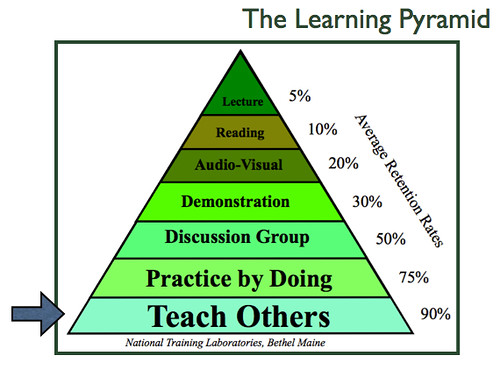
Ed. Note: The image below titled "The Learning Pyramid" is NOT based on any verifiable research; perhaps, no research at all (see this and that). This pyramid is widely cited yet it is, as Christopher Harris shared in a recent email, a hoax. Nonetheless, I stand by the idea that the marriage of teaching and content creation is a powerful pedagogical practice. (see the comments)


A paradigm of instructional design that suggests we create learning experiences for our students where they create content that educates.

I had a conversation with a couple of friends who teach at university. We were talking about how much variation there is not only in the nature of assessment in different classes but also what work merits an A (the highest grade) or an F (failure). Some professors consider a mark of 85% an A, some require more others less. Some determine students entire grades from a single exam or paper; others require several short papers, a mid-term, final exam, and a major research paper. And these variations can occur when different instructors teach the same course and students receive the same credit (or not) for different work.

(It's amazing to me that student societies don't protest this sort of thing.)

We're no better at the K-12 level. I once attended a workshop where 30+ math teachers graded the same set of three problems. Each teacher decided how many marks each question would be worth and converted the marks to a percentage. Scores varied from percentages in the 30's to the 80's.

I guess this is academe's dirty little secret: there are no assessment standards.

To its credit the National Council for Teachers of Mathematics (NCTM) published a set of Principles and Standards for School Mathematics in 1995 (updated in 2000). The document includes The Assessment Principle. These are guidelines only. Not all math teachers are members of the NCTM, not all math teachers are aware of these standards, and adherence to the standards is voluntary not compulsory.

One of my friends shared that she is required to ensure her classes achieve a predetermined average grade. I think that's unethical. Sometimes you get a strong group of students, sometimes a weaker group, more often it's somewhere in between. There really is no way to "predetermine" a class average. We all agreed it should be possible for a class to all achieve A grades or F grades.

I don't believe a student's grade in any course is a measure of their intelligence. I do believe it is a measure of the time, energy, and effort invested in the class. But I digress, that's another issue.

As we talked some more about assessment and pedagogy the conversation got a little more intense as I challenged my friends by saying: "If all you do is lecture do your students really need you? Couldn't they just read your assigned text, show up on test days, write the final exam and be done with it?"

That started us on a bit of a heated discussion about instructional design and assessment. What became really clear to me is that most instructors in university teach and assess their students at the bottom of Bloom's Hierarchy.

At one point, one of my friends said: "Look, we're not going to throw out hundreds of years of tradition because of what we think sitting here discussing this."

"That's not a fair criticism. It's not like there isn't scads of research in teaching and learning that I can point to supporting what I'm saying. I'm not making this up as I go along. The fact is, if you just lecture to your students, on average they're going to retain maybe 5% of what you say. You can do a lot better to make their learning sticky."

"If you really want to ramp up your teaching have your students create content that educates. That will naturally engage them at a higher cognitive level."

"You can require your students to demonstrate their understanding of what they are learning by having them apply their knowledge analyzing and evaluating relevant novel situations or problems. Better yet, get them to create content that educates an interested learner and they will automatically incorporate all those levels of engagement while they make their learning sticky. I don't need to tell you that there's nothing like having to teach a thing to make you really learn it.

The Twin Triangles

Photo credits: The University by Maddie Digital
Whispering by saaam
Bloom's Revised Taxonomy by dkuropatwa
Learning Pyramid by dkuropatwa
Bloom's Revised Taxonomy (revised) by dkuropatwa
The Twin Triangles by dkuropatwa

SMART tweets

We've just completed a unit of study in my grade 12 Pre-Cal 40S class. I call the kind of lesson we had today a "workshop." I prepare a series of problems as slides for the SMARTboard. The class is divided into groups of 3 or 4 students each. (Actually, this class is very big. All groups had 4 students and a couple had 5; not ideal working conditions but we do the best we can with what we've got.) They collaborate in their groups to solve each problem. Whenever they feel ready, anyone in the class spontaneously walks up to the SMARTboard and shares their solution. Other groups continue to solve the problem and analyze the work on the board for errors and "good form".

I'm really proud of how they work together and engage with the content and each other. It wasn't like this from day one but we've been working together for more than three months now. I was admiring their work today and wanted to share it. (In the back of my mind I was also thinking about how I would answer a question Ben Hazzard had thrown my way from this week's SMARTboard Lesson Podcast.) Anyway, I tweeted what they were doing as they did it. Ben Wilkoff suggested (tweeted) I share it here. Thanks Ben!

When the young lady working on the last problem hit a snag, several people spoke up to help her sort it out. Eventually, as time was running out of class, I helped them finish it off. After they solve each problem the first questions I ask are:

So, what do you all think?

Have they got that right?

How does it look?

Anyone want to change anything?

Any questions students ask are redirected to the student(s) who shared their work. They usually correct any errors with little or no prompting from me. If I do notice any errors they have missed I'll say: "There are X errors there. Can you find them?" or "This is good but it would have lost a few half marks. Can you see where?" Most of my comments focus on the wee technical details regarding how their work should be presented. I also point out the sorts of common errors that come up in tests and exams.

When I plan my lessons I try build them around these ideas:

Watch it. Do it. Teach it.

How can I make their thinking transparent to each other; and me?

They should touch the SMARTboard more often than I.

So, this is one way I use the SMARTboard in my class. It's just one piece of a larger whole in the way we use technology to support student learning. I'd love to hear what other folks do with their Interactive White Boards (IWBs).

Your thoughts?

Photo credit: Where's Batman?

This is important ...

Normally, national politics is not something I blog about. This issue is different. It crosses the boundaries of politics, technology and education; not just the spheres those words encompass but international boundaries as well. And it may really hurt students and teachers.

WHAT'S THE ISSUE?

Canada's Minister of Industry, Jim Prentice is about to introduce a new "copyright" bill to parliament strongly influenced by special interests outside Canada and the United States' DMCA. This is being touted as a Canadian DMCA; one that may be even more restrictive than the DMCA in the United States.

First a little context, and then why I think this is an important issue, not just for Canadian educators, but educators everywhere.

SOME CONTEXT

Michael Geist, a Canadian lawyer and professor of law, has been blogging about this issue full on for a while now. The CBC (Canadian Broadcasting Corporation, one of our two national media outlets) has a regular podcast called Search Engine (Clarence turned me on to this, I am now an avid subscriber. They talk each week about the intersection between the evolution of the internet and the society in which we live.). Search Engine has been podcasting about the new copyright bill for the last few weeks. The most recent 27 minute episode devotes the first 15 minutes to:

• summarizing the debate so far.

• articulating some of the controversy surrounding Minister Prentice's apparent lack of willingness to answer the concerns surrounding this legislation by the Canadian public.

• and the role Facebook played in starting a rally at the Minister's offices in Calgary last week. It includes some audio of the event and an interview with the rally organizer.

The good news is that the bill has been delayed until at least late January. Up until now, it has seemed as though the Minister was trying to rush the bill through parliament. The delay allows the government to take a more thoughtful and "technologically mature" (more about this below) approach to this legislation. More importantly, Canada, late to the "new copyright legislation" game internationally, has a real opportunity to play a leadership role illustrating how a technologically sophisticated society can try to find a balance between copyright holders and copyright users in the digital age.

WHY IS THIS IMPORTANT TO EDUCATORS EVERYWHERE?

My students are currently working on their Developing Expert Voices projects. (Last year's projects are here.) They are creating content, at the uppermost limit of their understanding, that educates an interested learner. They have to publish this content online. Mine is only one of many classes around the globe publishing their content online. Some of that content is remixed copyrighted material. Canada's copyright legislation doesn't include a fair use clause, that's an American legal concept; we have a fair dealing clause, it's a little more restrictive. Reading it won't lead to a straightforward answer to the question: "Can I use short video clips from a TV program in my project?" The current legislation doesn't even mention digital media of any sort, only print media. It needs to be updated.

The internet has made this a world without borders. When we publish content online it is distributed, within seconds, around the world. Copyright holders have rights. In Canada, so do copyright users. Exactly what those rights are is very murky, although Laura Murry (Queens U.) and Sam Trusow (U. of Western Ontario) have written a book to try and help clear it up a bit. Here is an excerpt:

As the Supreme Court declared in Théberge v. Galerie d’Art du Petit Champlain (2002), “Excessive control by holders of copyrights and other forms of intellectual property may unduly limit the ability of the public domain to incorporate and embellish creative innovation in the long-term interests of society as a whole, or create practical obstacles to proper utilization.” The court also noted, “Once an authorized copy of a work is sold to a member of the public, it is generally for the purchaser, not the author, to determine what happens to it.” In 2004, in CCH v. Law Society of Upper Canada, the Supreme Court was even more explicit about the importance of users’ rights.

Many teachers and parents have kids who are publishing work online. Work they can and should be proud of. The content they remix can come from anywhere, across any border. The read/write web is not just a computer geek phenomenon, it has impacted all cultures across the planet. This cultural shift, sometimes described as participatory culture, needs to be included in a modern approach to copyright legislation. The public, or copyright users, effected by this legislation span the globe.

If there is any doubt about the impact that participatory culture is having on our society listen to that episode of Search Engine. At 10 min. 43 sec. there is an audio excerpt from a recent sitting of the House of Commons (our national legislature). In particular listen to the comments made by one of the opposition Members of Parliament made at the 12 min. 23 sec. mark. When the significance of Facebook is referenced in political debate in the legislature it has clearly evolved into something more than a pastime for kids. (There is a group on Facebook, which today has over 26 000 members, called Fair Copyright for Canada.)

Kids should be able to share their learning in creative ways; they should be able to say what they've learned, differently. Their creativity should be encouraged and nurtured as they make positive contributions to the participatory culture in which we live. Copyright legislation that doesn't take this into account, from the perspective of the copyright user, will stifle creativity in our culture, our society and our children. No one says this more eloquently than Larry Lessig in his recently published TED Talk: 3 Stories and An Argument. If you haven't seen it, here it is:

WHAT (30 THINGS) CAN YOU DO?

Watch the video below, or read this. If you're not Canadian, don't let that stop you from expressing your opinion too. This issue will effect you; either as a user of Canadian copyrighted materials or when your nation's legislators begin to draft their modern copyright legislation. They'll look around at Canada, and other countries for guidance on how to draft it. What do you hope they'll see when they look over here?