SMART tweets

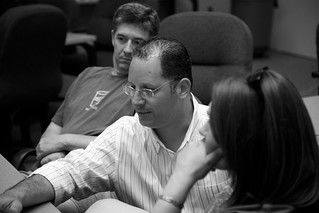
We've just completed a unit of study in my grade 12 Pre-Cal 40S class. I call the kind of lesson we had today a "workshop." I prepare a series of problems as slides for the SMARTboard. The class is divided into groups of 3 or 4 students each. (Actually, this class is very big. All groups had 4 students and a couple had 5; not ideal working conditions but we do the best we can with what we've got.) They collaborate in their groups to solve each problem. Whenever they feel ready, anyone in the class spontaneously walks up to the SMARTboard and shares their solution. Other groups continue to solve the problem and analyze the work on the board for errors and "good form".

I'm really proud of how they work together and engage with the content and each other. It wasn't like this from day one but we've been working together for more than three months now. I was admiring their work today and wanted to share it. (In the back of my mind I was also thinking about how I would answer a question Ben Hazzard had thrown my way from this week's SMARTboard Lesson Podcast.) Anyway, I tweeted what they were doing as they did it. Ben Wilkoff suggested (tweeted) I share it here. Thanks Ben!

When the young lady working on the last problem hit a snag, several people spoke up to help her sort it out. Eventually, as time was running out of class, I helped them finish it off. After they solve each problem the first questions I ask are:

So, what do you all think?

Have they got that right?

How does it look?

Anyone want to change anything?

Any questions students ask are redirected to the student(s) who shared their work. They usually correct any errors with little or no prompting from me. If I do notice any errors they have missed I'll say: "There are X errors there. Can you find them?" or "This is good but it would have lost a few half marks. Can you see where?" Most of my comments focus on the wee technical details regarding how their work should be presented. I also point out the sorts of common errors that come up in tests and exams.

When I plan my lessons I try build them around these ideas:

Watch it. Do it. Teach it.

How can I make their thinking transparent to each other; and me?

They should touch the SMARTboard more often than I.

So, this is one way I use the SMARTboard in my class. It's just one piece of a larger whole in the way we use technology to support student learning. I'd love to hear what other folks do with their Interactive White Boards (IWBs).

Your thoughts?

Photo credit: Where's Batman?

This is important ...

Normally, national politics is not something I blog about. This issue is different. It crosses the boundaries of politics, technology and education; not just the spheres those words encompass but international boundaries as well. And it may really hurt students and teachers.

WHAT'S THE ISSUE?

Canada's Minister of Industry, Jim Prentice is about to introduce a new "copyright" bill to parliament strongly influenced by special interests outside Canada and the United States' DMCA. This is being touted as a Canadian DMCA; one that may be even more restrictive than the DMCA in the United States.

First a little context, and then why I think this is an important issue, not just for Canadian educators, but educators everywhere.

SOME CONTEXT

Michael Geist, a Canadian lawyer and professor of law, has been blogging about this issue full on for a while now. The CBC (Canadian Broadcasting Corporation, one of our two national media outlets) has a regular podcast called Search Engine (Clarence turned me on to this, I am now an avid subscriber. They talk each week about the intersection between the evolution of the internet and the society in which we live.). Search Engine has been podcasting about the new copyright bill for the last few weeks. The most recent 27 minute episode devotes the first 15 minutes to:

• summarizing the debate so far.

• articulating some of the controversy surrounding Minister Prentice's apparent lack of willingness to answer the concerns surrounding this legislation by the Canadian public.

• and the role Facebook played in starting a rally at the Minister's offices in Calgary last week. It includes some audio of the event and an interview with the rally organizer.

The good news is that the bill has been delayed until at least late January. Up until now, it has seemed as though the Minister was trying to rush the bill through parliament. The delay allows the government to take a more thoughtful and "technologically mature" (more about this below) approach to this legislation. More importantly, Canada, late to the "new copyright legislation" game internationally, has a real opportunity to play a leadership role illustrating how a technologically sophisticated society can try to find a balance between copyright holders and copyright users in the digital age.

WHY IS THIS IMPORTANT TO EDUCATORS EVERYWHERE?

My students are currently working on their Developing Expert Voices projects. (Last year's projects are here.) They are creating content, at the uppermost limit of their understanding, that educates an interested learner. They have to publish this content online. Mine is only one of many classes around the globe publishing their content online. Some of that content is remixed copyrighted material. Canada's copyright legislation doesn't include a fair use clause, that's an American legal concept; we have a fair dealing clause, it's a little more restrictive. Reading it won't lead to a straightforward answer to the question: "Can I use short video clips from a TV program in my project?" The current legislation doesn't even mention digital media of any sort, only print media. It needs to be updated.

The internet has made this a world without borders. When we publish content online it is distributed, within seconds, around the world. Copyright holders have rights. In Canada, so do copyright users. Exactly what those rights are is very murky, although Laura Murry (Queens U.) and Sam Trusow (U. of Western Ontario) have written a book to try and help clear it up a bit. Here is an excerpt:

As the Supreme Court declared in Théberge v. Galerie d’Art du Petit Champlain (2002), “Excessive control by holders of copyrights and other forms of intellectual property may unduly limit the ability of the public domain to incorporate and embellish creative innovation in the long-term interests of society as a whole, or create practical obstacles to proper utilization.” The court also noted, “Once an authorized copy of a work is sold to a member of the public, it is generally for the purchaser, not the author, to determine what happens to it.” In 2004, in CCH v. Law Society of Upper Canada, the Supreme Court was even more explicit about the importance of users’ rights.

Many teachers and parents have kids who are publishing work online. Work they can and should be proud of. The content they remix can come from anywhere, across any border. The read/write web is not just a computer geek phenomenon, it has impacted all cultures across the planet. This cultural shift, sometimes described as participatory culture, needs to be included in a modern approach to copyright legislation. The public, or copyright users, effected by this legislation span the globe.

If there is any doubt about the impact that participatory culture is having on our society listen to that episode of Search Engine. At 10 min. 43 sec. there is an audio excerpt from a recent sitting of the House of Commons (our national legislature). In particular listen to the comments made by one of the opposition Members of Parliament made at the 12 min. 23 sec. mark. When the significance of Facebook is referenced in political debate in the legislature it has clearly evolved into something more than a pastime for kids. (There is a group on Facebook, which today has over 26 000 members, called Fair Copyright for Canada.)

Kids should be able to share their learning in creative ways; they should be able to say what they've learned, differently. Their creativity should be encouraged and nurtured as they make positive contributions to the participatory culture in which we live. Copyright legislation that doesn't take this into account, from the perspective of the copyright user, will stifle creativity in our culture, our society and our children. No one says this more eloquently than Larry Lessig in his recently published TED Talk: 3 Stories and An Argument. If you haven't seen it, here it is:

WHAT (30 THINGS) CAN YOU DO?

Watch the video below, or read this. If you're not Canadian, don't let that stop you from expressing your opinion too. This issue will effect you; either as a user of Canadian copyrighted materials or when your nation's legislators begin to draft their modern copyright legislation. They'll look around at Canada, and other countries for guidance on how to draft it. What do you hope they'll see when they look over here?

Inflection Points

The last three years have felt like a long ride in the Tilt-a-Whirl. Every week, sometimes every day, opened my eyes to new possibilities for what could be accomplished in the classroom. Scads of new (free) tools became available each day. My head snapped as I tried to assimilate new ways of thinking about teaching and learning.

I got used to it though. I've begun to generalize the way I think about each new tool. Does it have RSS? Can I link to it? Does it allow for tagging? embedding? The blog is still the hub for all these functionalities.

Most recently, Dean pushed my thinking a little further with his K12 Online presentation Design Matters. I've been thinking about the ideas he talked about there daily. They're slowly weaving their way into my classroom.

But now, it feels like the learning is slowing down. I've reached an inflection point; still growing, just much more slowly. I know from playing guitar that you reach these stretches where it feels like you're not really advancing anymore. Just doing the same things you've already learned. It feels like the learning stops. What I've found, playing guitar, is that a moment comes. Unexpectedly. Like a bolt from the blue. All that "quiet" time was really just my fingers getting ready to take the next leap.

I'm turning inward a bit now. Mulling things over. Thinking about how my teaching practices have consolidated over the last few years. Turning back to my roots.

I'm wondering what the next inflection point is going to look like. And when it's going to come.

Patience.

Hi. This is Darren Kuropatwa ...

Hi. This is Darren Kuropatwa. I'm just testing out a new service I found, jott.com. Where you can just make a quick call on your cellphone and Jott a message in audio. Then automatically it's posted to your blog. And I've never done that before so I wanna see what that's gonna look like. Now I can do it to Twitter and I can also send e-mail this way. So this is really interesting and I wanna see how this all plays out. Let me know listen Powered by Jott

Blogging: Does It Scale?

I'm participating in a forum as a mentor for a group of teachers learning about using web 2.0 tools in their classrooms. One of them asked about how would blogging across the curriculum and grades scale?

I don't know that there is a best answer but this is where I'm at in my thinking about it at the moment:

There are basically three models teachers use to blog with their students:

(1) A Comment Blog • The teacher creates the blog and is the sole authour.

• The teacher posts thoughtful (provocative?) questions to the blog and the students reply in the comments. They might even aggregate research (hyperlinked to sources) in the comments when prompted to by the teacher.

• This model is often used by teachers trying blogging for the first time. Nonetheless this can be an incredibly powerful use of blogging as exemplified in the, now dormant, A Look at Bullying blog.

(2) The Class Blog (this is what I do) • The teacher and students all share authourship and contribute content to the blog.

• The teacher structures the nature of the content that students are required to contribute and the students are free to contribute more as the mood moves them.

(3) The Mother Blog (Clarence Fisher does this. So does Barbara Ganly; I think she coined the term "Mother Blog.") • Each student has their own blog.

• The teacher runs a central blog that all the students subscribe to and check in on daily.

• The mother blog is linked to all the students blogs and vice versa.

• The teacher uses the mother blog to guide the students learning by:

» "handing out" assignments on the mother blog.

»aggregating and pointing to resources that may be useful in the students learning.

»highlighting exemplary work shared by students on their individual blogs. This drives traffic (comments) to that student's blog and models for the rest of the class what exemplary work looks like. (Powerful motivational consequences flow from this practice.)

How Might This Scale? If I were looking at a school wide implementation of blogging across the curriculum I would probably aim to have a fusion of (2) and (3) above:

»Each student would have their own blog where they aggregate all their work from all their classes through the years. Over time this becomes a concrete artifact of their learning. The content can also be remixed into a portfolio of all they have learned. Using a wiki to create that portfolio (pbwiki does this quite nicely) allows them to cross reference (using links) the opus of work archived in their individual blog.

»Each class would also have a class blog blog where the teacher could orchestrate and structure the class' learning experiences. All the content from that particular class would be aggregated in the class blog. Students would cross post (copy and paste) any content they create to both their personal and class blogs. Teachers may pursue a "mother blog" concept with their classes too simply by cross linking the student's blogs and the class blog.

»When students "graduate" from whatever school they are attending (elementary to high school, high school to university, etc.) they would take their individual blog with them. Hopefully, when they leave secondary school, they will continue to use their blog to capture their learning for the rest of their lives.

One virtue of setting things up this way is that it transparently models and provides the tools for life long learning.

Are there other benefits? shortcomings?

Are there obstacles to implementing this? What are they?

What do you think? ;-)

Photo Sources: untitled by flickr user stranded_starfish
node by flickr user uqbar

After The Party: MBEdubloggercon

We had a great night! There were over 60 people in the room, some familiar faces and lots of new ones too. My only regret was that I didn't get a chance to talk to and meet more of the people who were there. The real hero of the evening, IMHO, was Andy McKiel, the president of our provincial Ed. Tech. association, MANace. Andy organized the evening and made sure all the technology ran flawlessly. This never would have happened without him. At one point during the evening, all of us who were presenting were chatting; we unanimously shared how grateful we were for all of Andy's hard work. Thanks Andy!


Created with Admarket's flickrSLiDR.

I've just updated the Manitoba EdubloggerCon wiki. We had a live Twitter feed and UStream feed. All the videos of the unpresentations can be seen from the Manitoba Edubloggercon UStream account or the wiki.

The next day, yesterday, Chris, Clarence, Dean, John and I had lunch together to catch up and chat. Unfortunately, John had to leave early but as we lingered over the end of the meal, Dean fired up his laptop and started streaming video and audio on his Ustream channel. We were joined for lunch by over 20 people from across the world. We forgot to click the record button so we've lost the video archive but Clarence saved the chat which you can download from his blog or read directly on the MBEdubloggercon wiki (it's easier to follow the links off the wiki page). There was lots of interesting discussion and some good links shared. One of them led me to a voicethread archive of lots of math content that's giving me ideas for how I can use it in my classroom. That's also a resource I can link to and use in my Consumer Math 20S (grade 10, approx. 15 y.o.) class. (My daughter (7 years) and I watched this one this morning and left a comment on the last slide.)

Dean took some photos at lunch. I aggregated them into this voicethread. (I know Dean wants to hear lots of comments about the salad (slide 2) I had with my lunch.) I haven't had a chance to add any comments yet. Feel free to add yours before I do. ;-)

One thing that came out loud and clear (you can see it in the chat transcript) is that our ideas about what good professional development should look like have changed dramatically. It's not worth our time unless it provides an opportunity to engage with what's being shared by dialogging about it. And that dialogue should include global participation via twitter, UStream or some other way to access our learning networks. More than that, archiving the experience somehow is also important. The archive provides people who were there the opportunity to go back and reflect on what they heard/learned/participated in and offers other educators around the world an opportunity to participate vicariously after the event and add their voices to the conversation.

Having been immersed in "networked learning" for a while now, the power of the network to connect and amplify learning still amazes me every time. Even my 7 year old daughter got something out of all this. Thanks to an email I got from Brian Metcalfe (who attended the event on Thursday night) while I was chatting with Dean this morning we're talking about an idea that may make math a little more fun in classrooms across the world, in March ... on the fourteenth, to be exact. ;-) I'll share more about it here as we flesh this out.

Like I keep saying to my students, again and again, "Learning is a conversation. If you're not talking to someone about it, you're not learning it."

Thin Walled World

So much to blog, so little time ... but this is exciting (at least it is to me) and I wanted to archive it here in my outboard brain.

I have had online mentors working with my classes for about two years now. Lani Ritter-Hall has been there from the beginning and continues to model the art and science of effective blog mentorship. (This latest example was fantastic! The kids faces as they heard her voice for the first time was priceless.)

Alec Couros and I are collaborating with his two classes of student teachers mentoring my classes via their blogs this year as well. For the last six weeks they have worked mostly with my Consumer Math 20S (grade 10, aged approx. 15 years) class and recently begun expanding their work to my Pre-Cal 40S and AP Calculus classes. I think it has been something of an eye opener for the student teachers to compare the nature and pace of work and the character of the online interactions in the different classes.

The students in my AP Calculus class have been mentored online going on three years now. I have had the good fortune to teach this same group of kids for three years in a row; I have taught them all their high school mathematics. The group is much smaller now; we're at 11 students down from nearly 30 in grade 10, one of whom is new to the group.

Anyway, their learning has been enriched via these online mentorships and they have started to think of ways they can pay it forward and maybe get a good reference for scholarship applications they will be making in the near future.

Clarence and Barbara are pushing the boundaries of education this year in their Thin Walled Classroom. The students in "this class" are learning at least one thing together each day. Using a suite of online tools, they are creating a classroom with very thin walls where the kids have teachers in two countries and two time zones; one they see face to face, one they don't. (Man, how I wish my own kids were students in this classroom.)

When three of my AP Calculus students approached me with the idea of of taking on the role of blog mentors I tweeted about it and got three bites in short order. I shared the urls of the people who were interested and my kids chose to work with Clarence and Barbara in the Thin Walled Classroom. I have letters of permission from their parents that I keep on file and am keeping tabs on their work from my end. Clarence asked them to be positive in their comments but also to push the younger students and challenge them in their work to help them amplify their learning. They are not to act as cheerleaders but as catalysts for growth. (After their experiences being mentored by Lani for these last few years they knew exactly what the expectations were.) Clarence also asked them to archive and email him with the comments they leave behind every five or six comments or so. It struck me that it would be much better to use a blog to record their comments.

Using Blogger allows the functionality of emailing a post to a unique, user determined, address where the subject line becomes the post title and the body, including all formating, become the body of the blog post. (See my recent test.) Each of my student/mentors is building a blog where they will archive their comments and post urls to the students in the thin walled classroom. After they have done this for a few weeks they will go over the comments they have left behind and post a brief reflection about the work they have done and how they can improve it in the future. This also makes it really easy for Clarence, Barbara and I to monitor their work and creates a concrete artifact they can point to when they reference this work in their scholarship applications.

Yesterday, the first of the new student mentor blogs went live. Grey-M's new blog is called Advice Through Ethereal Walls. He left his first comment to Hannah whose blog is called Believing is Succeeding (great name for an edublog).

I was so taken with this idea that I went to share all this with my principal and discuss how I see this evolving in the future.

How would it be if students who begin grade 9 or 10 at my school, in blogging classes, are mentored via their blogs so that by the time they reach grade 12 they can assume the role of mentor as well to pay it forward? Commenting/mentoring students in the younger grades in our school and our feeder schools builds a self sustaining model so that by grade 12 we may have a cadre of blog mentors that can support the learning of students in our community and abroad. After all, thanks to blogging, we live in a thin walled world.

He liked the idea. We'll see where it goes.

In the mean time feel free to mentor the mentor by dropping in on Grey-M and wishing him well on the launch of his latest blogging adventure.