The Character of Test Questions

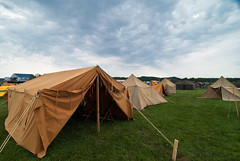
TentsImage by rwillia532 via Flickr

In my math classes a typical test is modeled on the character of test questions students will see on their final exams: multiple choice, short answer and long answer.

In a grade 10 math class, what we used to call Applied Math 20S, a multiple choice question might be:

A factory makes tents.  The cost of running the factory is $300 per day plus $50 for each tent made. What is the total cost (C), in dollars, as a function of the number of tents (t) made?

(A) C = 350t (B) C = 50t + 300 (C)  C = 300t + 50 (D) t  = 300 + 50C

I like this question because it quickly allows a student to show whether or not they understand what a "function" is and it's easy to grade. While they have a 25% chance of getting it correct by guessing, in the context of the entire test, and their classroom experiences with me (read: conversations), I know if a student has grasped the concept.


Me and my CellImage by dkuropatwa via Flickr

A short answer question might be:

The monthly cost, C,  in dollars, of using a cell phone is calculated using the function C(t) = 0.09t + 20 where t is the time in minutes. What is the monthly fee and the cost per minute for this cell phone contract?

Another quickie that reveals whether or not the student can decode the information given in a function. Another question might ask them to reverse that; encode a function given the description of a linear relationship. As a matter of fact, there's a fundamental principle there about learning math: Anything you can do you should also be able to undo. i.e. If you can decode the information in a function you should also be able to encode information in a function.

Here's a long answer question: 

The cost of a school graduation dance has a fixed cost of $1500 for the band, security, and so on, and a cost of $22 per plate for every person attending.
(a) Write the formula which states how the total cost, C, is related to the number of people attending, n.
(b) What is the slope? What does it mean?
(c) If the maximum capacity of the hall is 225 people, what is the maximum cost of the dance?
(d) State the domain of this function.
(e) State the range of this function.

The question is not ideal; (d) should be a "gimme" if they understood (c) and (e) depends on the formula they created in (a). Mind you, if they wrote an incorrect formula in (a) but correctly applied it in (e) that's worth full marks in (e).

Image by nebbsen via Flickr

Something these three questions have in common is they require that a student understand the meaning of the marks they're making on the page. While every test has some straight forward calculations, by and large calculations are what computers do best. I want my students to understand what the math means and how it hangs together. Computers don't do that so well; although they're getting better at faking it. That's largely because of the cleverness of people who understand the math behind what computers do.

If your assessments largely test mechanical skills that's what your students will focus on learning. If your assessments test for understanding that's what your students will focus on learning. Which would you rather learn?

You don't have to teach math for any of the above to be true, do you?

That's Really Hard Work

Cross posted from the November Learning blog.


Community First

Michael Wesch by flickr user poptech
Michael Wesch's keynote this morning was simply breathtaking. In the follow up breakout session someone asked him: "How do you stop students seeing themselves as students, and as collaborators?"

Mike sighed, put both hands on the podium and said: "That's really hard work."

He went on to explain "community first." He uses the first two weeks of class to build a sense of community and togetherness in a shared quest to solve a real world problem. A problem he himself doesn't know the answer to.

"Doing crazy things together creates community." 

Micheal plans his most passionate and enthusiastic lectures for those first two weeks. And he has his students do zany ice-breaking activities to help them get to know each other and break through the veneer of passivity they arrive in his class with. But it's not just about having fun; these activities (like human scavenger hunts) all have a serious edge to them. They have to see that they'll have fun learning here, but we are working hard at learning.

The Lesson Design Arc: schedule-research-paper-video 

The kids begin by co-creating a schedule on a wiki for the research they'll do to solve the problem they've decided to work on. They begin by digging into the problem and reading everything they can on it. Summaries of all their reading are compiled on the wiki. Typically they'll read over 90 articles, papers, or books in the first week of class as they do this. (In more typical University classes they read about three articles in the first week.) Mike guides them, having a little deeper experience in the field then they do, by suggesting other sources they might wish to explore. They continue this research and co-create a research paper for publication. When that's all done, they create very brief condensed video summaries of their research, submit them to Mike who then weaves them together into a brief (5 min?) video. All this is only possible because of the community building work they do together in the first few weeks of the course.

There's a lot more to all this, I'm just summarizing (his integrated, collaborative, calibrated peer review assessment scheme – which goes well beyond <-- that link back there – is brilliant), but that's the broad strokes takeaway I got.

When Things Go Wrong

My Pencil by flickr user jbelluch
Sometimes, when people work together closely on a real world problem things wrong. People get upset. Students goof off in class.

When that happens Mike intervenes using a ritual he learned from an African(?) tribe. It's very similar to the Talking Stick ritual used by many First Nations people of Canada. They use pencils instead. Anyone who is holding the pencil lets go of the little voice in their head that says "You can't say that." and speaks from the heart about what's upset them. The rest of the group talks with them about it. They don't put the stick down until they've resolved whatever the problem is. Mike usually goes first. Sometimes he cries while he's talking to his 400+ students. Then the next person in the group takes their turn.

A Pedagogy to Aspire To

Isn't that an amazing example of "intense imagination, motivation, emotion, and thought?" I had wanted to write about the amazing conversations going here: in the halls, in sessions, over lunch, every time someone stops me to talk really. But this morning's keynote. Just breathtaking. Good teaching is what comes from building strong relationships between teachers and students; relationships with a serious educational edge. (I hear echoes of John Seely Brown in this.)

I've got to think more about how to weave together such a set of diverse sensitivities into my teaching. How do you build a culture of caring in your class?

Sharpening The Saw

I've been using a SMARTboard in my class for a little more than two years now. I know I've seen dramatic growth in the way I teach and present information to my students in no small part because of it.

I'd like to publish a series of posts transparently sharing how I use the SMARTboard to teach math and encourage anyone who reads/hears it to leave me suggetsions on how I might better use the affordances offered by the SB. Please share your critiques, comments, concerns, questions, complaints, confusions, uncertainties, anxieties, and suggestions for improvement with me by leaving a comment on this post or directly in the VoiceThread I've created to share my process.

I'd encourage other teachers to do the same; we could learn a lot from each other this way.

LINKS FOR THIS LESSON

Teaching Slides
Student Authoured Scribe Post

Thanks!

And Calculus For All

When I returned to work after 10 weeks of parental leave I wanted to find a way to measure how well my AP Calculus students had learned and understood what a derivative was. So, the day I returned to class I challenged them to create a commercial that educates: What is a derivative?

Some of the parameters they have are:

  • The video must educate people who know nothing about calculus.
  • The video must be published on YouTube.
  • Students may work in teams of up to 3 people.
  • No images of students faces. Masks or other methods of obscuring their identities may be used.
  • No algebra.
  • Maximum video length: 30 seconds.
  • Include as many different descriptions as possible in the time allowed.

The way we're doing this is I have published a video to YouTube describing the assignment and extended it as a challenge to the entire math community on YouTube. Students will "hand in" their commercials as video replies to mine.

I'm hoping other people in the math community on YouTube reply to the challenge. It will go a long way to adding another layer of authenticity to the assignment and create a more meaningful reason than "marks" to create high quality content: social credit.

Social credit is a powerful motivational force in the lives of teens; a force that hasn't fully been tapped in educational circles. It's behind the outstanding work some of my students do on their class blogs. I'm trying to be more deliberate about accessing that potential in new ways this year.

The video has just been published to the AP Calculus 2008 blog. The students commercials should be published by Friday morning.

If you have a moment, head over to their blog and leave them a comment telling them you're looking forward to their commercials. It'll help make real their sense of audience and perhaps encourage them to do their very best before they hit the publish button on their videos.

Calculus Commercial Seed Video

Photo Credit: Excuse Me Ma'm... by flickr user nobleignoble

Assessment and Rote Learning

David Truss has a great post called Assessment & Rote Learning: Math Conundrums. I tried to leave a comment. I discovered I'm passionate about what Dave had to say. The blog, or my cocomment plugin, borked (yes, that's a technical term) and wouldn't let me leave the comment so I decided to share it here. You may like to read Dave's post before continuing with this.


Breathtaking post, or was it three? ;-)

Assessment

I did the same exercise with my dept. We also had the same vastly differing results you did. At a provincial in-service about 9 or 10 years back I participated in the same exercise using real student generated work. Results varied from around 33% to 80%. This is one facet of Academe's Dirty Little Secret. Anyway, in my dept. we've been looking at how we assess all the content in all the courses we teach; one course at a time, one unit at a time. We're trying to develop a consistent approach to assessment at least within our building. We'll be "at it" for a while yet.

Basic Skills

Fluent knowledge and recall of basic addition, subtraction, multiplication and division facts are essential for ANY student to experience success in math. I'm on the same page you are Dave.

A grade 9 student, who struggles (mightily) with her multiplication facts, and I were talking about this last week. As I was trying to help her I asked why she thinks I feel it so important for her to become fluent in her recall of the multiplication table:

"I know, I know, some day I might not have a calculator and I might need to multiply two numbers."

[Oy! Who tells kids this stuff? And do they really believe that? -- I mean the adults, not the kids. I know the kids don't believe that.]

"No. That's not why. You'll always be able to get a calculator if you need to multiply a bunch of numbers. That's not the reason. It's that you need to know the language of math so you can join the conversation."

"If your teacher is trying to teach you why multiplying pairs of negative numbers always have a positive result, or why, when we divide fractions, we 'multiply by the reciprocal' they're going to talk about stuff like 7x8 and assume you know it's 56 and go on to discuss some deeper ideas. If you're hung up on 7x8, need to pull out a calculator, you're going to miss the entire conversation. Your brain will be back 5 steps while everyone else is talking about this other stuff. By the time you figure out what's going on you won't know what's going on. You'll feel lost and confused and fall farther behind."

"Why do I need to know math anyway?"

"For the same reason you need to know how to read. Because it's a fundamental way that humans communicate with each other and understand the world around them. If you can read but you can't understand mathematics then there will be giant tracts of things happening in the world around you that you'll never understand."

[Whew! Went on a bit of a rant there. I'm going to get a cup of tea ... Cheers Dave!]

Photo Credit: Conundrum by flickr user wyld stallyn

Developing Expert Voices Rubric v1.1

I should have stuck to my instincts.

When we were putting this rubric together the students argued strongly that the "Solutions" and "Annotations" categories should be combined into one. I felt they should be two. Now, as I assess their work I have students who have written Expert Level annotations. If I find even one error, according to the rubric that would move them down to Journeyperson Level.

We discussed it and we're splitting them back into two different categories. We felt that the annotation should be weighted significantly more heavily than the solutions because that's where the real teaching part of the assignment comes into play.

So, here it is, updated in progress, DEV Rubric version 1.1 ... in eternal beta. ;-)

Oh, and BTW, check out some of the amazing work they've been doing ... the leaving of comments is greatly appreciated and strongly encouraged. ;-)


Teaching mathematical concepts is the main focus of this project; so we can teach other people and learn at the same time.

Achievement Descriptors
Instead of levels 1-4 (lowest to highest) we use these descriptors. They better describe what this project is all about.

Novice: A person who is new to the circumstances, work, etc., in which he or she is placed; a beginner.
Apprentice: One who works for an expert for instruction or to learn a skill or trade.
Journeyperson: Any experienced, competent but routine worker or performer.
Expert: One who possesses special skill or knowledge; trained by practice; skillful and skilled.

Achievement
Mathematical Challenge (25%)
Annotation (40%)
Solutions (15%)
Presentation (20%)
Novice Problems illustrate only an introductory knowledge of the subject. They may be unsolvable or the solutions to the problems are obvious and/or easy to find. They do not demonstrate mastery of the subject matter. Explanation does not "flow," may not be in sequential order and does not adequately explain the problem(s). May also have improper mathematical notation. One or more solutions contain several errors with insufficient detail to understand what's going on. Presentation may or may not include visual or other digital enhancements. Overall, a rather uninspired presentation. Doesn't really stand out. It is clear that the student has invested little effort into planning their presentation.
Apprentice Problems are routine, requiring only modest effort or knowledge. The scope of the problems does not demonstrate the breadth of knowledge the student should have acquired at this stage of their learning. Explanation may "flow" well but only vaguely explains one or more problems. Some parts of one or more solutions are difficult to follow. May include improper use of mathematical notation. One or more solutions have a few errors but are understandable. The presentation style is attractive but doesn't enhance the content; more flashy than functional. It is clear that the student has invested some effort into planning their presentation.
Journeyperson Problems showcase the writer's skill in solving routine mathematical problems. They span an appropriate breadth of material. One or more problems may require careful thought such as consideration of a special case or combine concepts from more than one unit but not necessarily. Explanation "flows" well and explains the problems step by step. Solution is broken down well and explained in a way that makes it easy to follow. May have minor use of improper mathematical notation. May point out other ways of solving one or more problems as well. All solutions are correct and easy to understand. Very few or no minor errors. The presentation may use multiple media tools. The presentation style is attractive and maintains interest. Some of the underlying message may be lost by some aspects that are more flashy than functional. It is clear that the student has given some forethought and planning to their presentation.
Expert Problems span more than one unit worth of material. All problems are non-routine. Every problem includes content from at least two different units. Problems created demonstrate mastery of the subject matter. Showcases the writer's skill in solving challenging mathematical problems. Explanation "flows" well, explains the problems thoroughly and points out other ways of solving at least two of them. All solutions correct, understandable and highly detailed. No errors. The presentation displays use of multiple media tools. The presentation style grabs the viewer's or reader's attention and compliments the content in a way that aids understanding and maintains interest. An "eye opening" display from which it is evident the student invested significant effort.

Creativity (up to 5% bonus)
The maximum possible mark for this assignment is 105%. You can earn up to 5% bonus marks for being creative in the way you approach this assignment. This is not a rigidly defined category and is open to interpretation. You can earn this bonus if your work can be described in one or more of these ways:

  • unique and creative way of sharing student's expertise, not something you'd usually think of;
  • work as a whole makes unexpected connections to real world applications;
  • original and expressive;
  • imaginative;
  • fresh and unusual;
  • a truly original approach; presentation method is unique, presented in a way no one would expect, e.g. song, movie, etc.

Developing Expert Voices Rubric out of beta v.1.0

This is the final version of the document published to all the class blogs.


Developing Expert Voices Rubric

The teaching of mathematical concepts is the main focus of this project; so we can teach other people and learn at the same time.

Acheivement Descriptors
Instead of levels 1-4 (lowest to highest) we use these descriptors. They better describe what this project is all about.
Novice: a person who is new to the circumstances, work, etc., in which he or she is placed; a beginner.
Apprentice: to bind to or place with a master craftsman, or the like, for instruction in a trade.
Journeyperson: any experienced, competent but routine worker or performer.
Expert: possessing special skill or knowledge; trained by practice; skillful or skilled.


Acheivement
Mathematical Challenge (25%)
Solutions (55%)
Presentation (20%)
Novice Problems illustrate only an introductory knowledge of the subject. They may be unsolvable or the solutions to the problems are obvious and/or easy to find. They do not demonstrate mastery of the subject matter. One or more solutions contain several errors with insufficient detail to understand what's going on. Explanation does not "flow," may not be in sequential order and does not adequately explain the problem(s). May also have improper mathematical notation. Presentation may or may not include visual or other digital enhancements. Overall, a rather uninspired presentation. Doesn't really stand out. It is clear that the student has invested little effort into planning their presentation.
Apprentice Problems are routine, requiring only modest effort or knowledge. The scope of the problems does not demonstrate the breadth of knowledge the student should have acquired at this stage of their learning. One or more solutions have a few errors but are understandable. Explanation may "flow" well but only vaguely explains one or more problems. Some parts of one or more solutions are difficult to follow. May include improper use of mathematical notation. The presentation style is attractive but doesn't enhance the content; more flashy than functional. It is clear that the student has invested some effort into planning their presentation.
Journeyperson Not all the problems are "routine" in nature. They span an appropriate breadth of material. At least one problem requires careful thought such as consideration of a special case or combines concepts from more than one unit. Showcases the writer's skill in solving routine mathematical problems. All solutions are correct and easy to understand. Very few or no minor errors. Explanation "flows" well and explains the problems step by step. Solution is broken down well and explained in a way that makes it easy to follow. May have minor use of improper mathematical notation. May point out other ways of solving one or more problems as well. The presentation may use multiple media tools. The presentation style is attractive and maintains interest. Some of the underlying message may be lost by some aspects that are more flashy than functional. It is clear that the student has given some forethought and planning to their presentation.
Expert Problems span more than one unit worth of material. All problems are non-routine. Every problem includes content from at least two different units. Problems created demonstrate mastery of the subject matter. Showcases the writer's skill in solving challenging mathematical problems. All solutions correct, understandable and highly detailed. No errors. Explanation "flows" well, explains the problems thoroughly and points out other ways of solving at least two of them. The presentation displays use of multiple media tools. The presentation style grabs the viewer's or reader's attention and compliments the content in a way aids understanding and maintains interest. An "eye opening" display from which it is evident that the student invested significant effort.


Creativity (up to 5% bonus)

The maximum possible mark for this assignment is 105%. You can earn up to 5% bonus marks for being creative in the way you approach this assignment. This is not a rigidly defined category and is open to interpretation. You can earn this bonus if your work can be described in one or more of these ways:

  • unique and creative way of sharing student's expertise, not something you'd usually think of;
  • work as a whole makes unexpected connections to real world applications;
  • original and expressive;
  • imaginative;
  • fresh and unusual;
  • a truly original approach; presentation method is unique, presented in a way no one would expect, e.g. song, movie, etc.


Flickr Assignment Roundup

I spent the better part of December blogging about the flickr assignment I developed and the process and product of the rubric that we generated. It seems to have struck a chord with some folks as I continue to get email from people asking about the both the process and product.

Once again, accessing my "outboard brain" (this blog -- kudos again to Brian for that metaphor) I've compiled all the posts about the project here in the order that they were published.

See the end for an update on how the assignment has evolved since I last wrote about it.

This rubric was published to all the class blogs. I also gave each student a hard copy of the rubric. This hard copy doesn't have the links to examples that the online version does. It is also missing some descriptive text that is included in the online version.

Having the students assess their work and hand it in, I feel, made them more accountable for their grades. Some of them didn't do the assignment. They handed in a page today, with their name on it, that had only the words Level 0 circled.

Next semester I plan to do this assignment again. I will reopen the rubric to the new students for editing. They will benefit by at least having a more concrete set of guidelines to begin with.

Flickr Assignment Rubric v1.0 - We're Out of Beta!

Here is the rubric we've settled on together.

It's been an exhilarating experience watching the kids develop this. There were several points where Lani and I asked pointed questions about things that needed to be considered. Not everyone participated online. A few more participated in the class discussions we had. We never really got 100% of the students involved but those that did participate made excellent contributions to the document and the thinking behind it. It took me about an hour today to finally bring together everyone's ideas and edit the final version of the document below.

Looking back at the process and the thinking that went into it I find it interesting how the Hot Spot category earned the greatest attention and discussion. While there was some discussion about the mechanics of using hot spots (they shouldn't cover each other up) the better part of the conversations we had, and thinking we did, centered around how they can best be used to capitialize on their functionality. How the hot spots can best be used to connect with the mathematics these pictures are supposed to summarize.

The introduction to the rubric below was added last night as a footnote by one of the students summarizing their input on the document. Today the students in all my classes felt that it should be preserved. I suggested it become the overview of the assignment. We all agreed.

Anyway, here it is, version 1.0 fresh out of beta. ;-)


Flickr Assignment Rubric
It is paramount that the picture be in tune with the purpose of the assignment. It should show, first of all, the student's understanding of how the photo is related to mathematics. The hot spots are important too, because that's essentially your way of teaching other people. Creativity is a factor, because keeping one's interest in the photo contributes to the learning process. Finally, the picture quality should be kept in mind too. If we can't see the picture, it's going to be hard achieving all the other requirements.

Tags

The picture must be tagged properly with the course tag and assignment tag. If tags are misspelled or no tags are present the photo cannot be graded and will receive a grade of ZERO. Not tagging your photo properly and accurately is analogous to not handing in your work or not putting your name on it.


Classification
Mathematical Content (50%) Hot Spots (35%) Photograph (15%)
Level 4
Packed with mathematical concepts/facts. (Minimum 7 concepts/facts.) All hot spots accessible; i.e. "smaller" hot spots are "on top" of larger ones, they do not obscure each other. All hot spots are actually labels and relate to parts of the photo (not on blank space with filled in notes). One or more hot spots include a link to a relevant supporting resource on the internet. Minimum 7 hot spots. In focus or appropriately focused for effect. The subject of the picture occurs "naturally," it is not a contrived shot. Really makes the viewer "see" math in a place they hadn't realized it existed. (Example: trigonometry)
Level 3
Significant number of concepts/facts included. (Minimum 5 concepts/facts.) All hot spots accessible. Most hot spots are actually labels and relate to parts of the photo. Not more than one hot spot on blank space. One or more hot spots may include a link to a relevant supporting resource on the internet. Minimum 5 hot spots. In focus or appropriately focused for effect. The subject of the photo has been "set up" or contrived yet still illustrates math found in "the real world." (Example: derivative)
Level 2
Some effort to include content evident. (Minimum 3 concepts/facts.) Most hot spots accessible. Most hot spots are actually labels and relate to parts of the photo. More than one hot spot is on "blank" space. May or may not include links to relevant supporting resource on the internet. Minimum 3 hot spots. In focus or appropriately focused for effect. Although it is a "real world" picture, objects have been used to "draw" the math. An obviously contrived shot. (Example: trigonometry)
Level 1
Very scarce content related to assignment. Less than three hot spots are visible or have information related to the theme of the assignment. It is evident that little effort went into finding and shooting a picture that reflects the theme of the assignment.
Level 0
Content unrelated to theme of assignment. No hot spots or mostly unrelated to the theme of the assignment. Out of focus and/or otherwise difficult to look at.

Creativity (up to 5% bonus)

The maximum possible mark for this assignment is 105%. You can earn up to 5% bonus marks for being creative in the way you approach this assignment. This is not a rigidly defined category and is open to interpretation. You can earn this bonus if your work can be described in one or more of these ways:

  • unique and creative way of looking at the world, not something you'd usually think of;
  • original and expressive;
  • imaginative;
  • fresh and unusual;
  • a truly original approach.


Flickr Assignment Rubric - in progress

I wanted to capture our "work in progress" as we develop the flickr assignment rubric. Many of the comments that have been made are still contained in this doc. Reading it from top to bottom is not the order in which the comments were made; it's been done asynchronously over the last week. There have been significant changes to the document over this time that are not captured in this 11th hour snap shot of the collaboration. Students (and Lani and I) have been adding comments in different colours to distinguish different authours although this hasn't always been consistent. It may be hard to make out some of the coloured text against the background of the blog. I'm fascinated by the discussions the students have been having as they work through this. They have until tomorrow morning to finalize everything. I will republish the final rubric tomorrow when it's done.


Flickr Assignment Rubric

To All My Students
I've started putting together a rubric to grade your future flickr assignments. I'm opening this document to all of you to help build the rubric. So far I've included only 3 categories:
Tags (no or incorrect tags, no marks)
Mathematical Content (50% of total mark five point scale 0 to 4)
Photograph (what percent of the mark should it be worth? What are the descriptors for each level?)

Questions: What other categories should we have?
Should it be marked on a 5 point scale (0 to 4) or just "done" or "not done."
(Do you think having a category for photograph, and a separate one for hot spots would be of value? -Lani)


Feel free to add to this document and make whatever changes you like. Together we'll build a better assignment. ;-)

The Goals (Feel free to add to this.)

  • Learn to look at the world through mathematical eyes and see the math in everything, everywhere.
  • In the course of looking for the pictures and creating the annotated hot spots think about old material in a new way. Strengthen the mental links you have to concepts already learned. Make learning sticky.
  • Creating digital mind maps of old material. Each student contributes one to the pool. At exam time you can review all the annotated pictures in the pool made by yourselves and your classmates. Teach and learn from each other.
  • Build a permanent resource collection by creating a course specific set of real world "clip art." You can use the pictures in projects, assignments and blog posts. I will also be able to use them the next time I teach the course to benefit the next group of students. You will be teaching people you have never met.
  • Feel free to add more pictures that you think will benefit everybody in their studies.
  • Have fun with this! Maybe involve your families and friends in your learning like getting them to add their own pictures. You could post the pictures for them.


THE RUBRIC
Tags (1%) (Mr. K. says:
OK, you only want this to be worth 1%. But if the photo isn't properly tagged I can't find it and therefore cannot mark it. That's why I had this as "Improperly tagged = -100%" and no marks for proper tags. We need to have something here about proper tagging and me finding/marking the photo.) (Angry Chipmunk agrees)(Jefferson says: have it worth 5% so it wouldn't cost as much but significant enough to motivate the student to tag it properly) ( Oliver says: I agree with Jefferson, how about 4% though :) .. ) (i think that tags should be worth 10% so that students will really make sure that their tags are the correct tag for that assignment~ruschev)(we still have the same problem, if they are not tagged they can't be marked because they can't be found.)
-100% Tags are misspelled or no tags are present so therefore photo cannot be graded and will be given a ZERO. (i agree, if its not there or misspelled its impossible to find, and therefore is not handed in... this should be -100% ... sorry guys :P ~Lisa)

-tennyson 12/21/06 : well anyone can make a mistake on tags., so i think tag worth 1 percent is ok, but tag are pretty eazy,can u say easy mark, so it should be like alil bit more.

Tags should be worth 5- 10 percent. Why? For those who can't make a simple tag for their work, they should lose on this section. What is a piece of work if you don't tag it. An example,creating a theory and you do not put your name or credit yourself. It only takes about 10 seconds to label your work. anything below 5 percent is too low. Anything higher than 10 percentis too much for tag marks. ~Mark


[i think that a photo with an incorrect tag OR with no tag at all should be awarded ZERO and i think we should keep it that way. Why would someone want a -100%? Is it really necessary to give a negative mark to someone who did not label their flickr assignment? ~ zeph]

(I think you're right zeph, actually, what you said is what I meant. - Mr. K)


Mathematical Content (50%)
4- Packed with mathematical concepts/facts. (Lani wonders should there be a stated minimum number of mathematical concepts/facts?) (Jefferson says: half of me says yes because it will give students a required minimum to think of facts and concepts, the other half says no because one concept can relate to the entire photo "quality over quantity") ( Oliver says: I believe we should have a minimum mathematical concept/facts. )(Jefferson: if we were to minimal concepts, where would it fit in the rubric?) ( Oliver says: I believe there already is marks for minimal hot spots ) (this one looks good to me, I like how you've outlined how many are required for an ok mark.. that way we can all make sure we've got extra so that we can all get exceptional marks like i know we can :D)
3- Significant number of concepts/facts included.
2- Some effort to include content evident. (minimum of 3 hot spots with mathematical concepts/facts)
1- Very scarce content related to assignment.
0- Content unrelated to theme of assignment.

Hot Spots (30%)

4- , all hot spots accessible (not covered by other hot spots), all hot spots are actually labels and relate to parts of the photo (not on blank space to just fill in notes). (Lani wonders about "(not covered by other hot spots)"; I viewed one assignment which was exceptional where the hot spots overlapped. Is that the same as covered?) (no, I meant where hot spots "cover" each other in such a way so that the spot underneath cannot be accessed -- imagine a large square on top of, covering, a small one. -- Mr. K. ;-) )
3- Hot spots work to a certain degree, and less information in each hot spot. Most of the hot spots are visible and are easily accessed.
2- At least 50% of hot spots are working and are fairly easily seen.
1- Some hot spots are visible and only some of the hot spots have unrelated info (Ben:is this good?)The hot spots always work, the real question is are they ... appropriate(?)/accessible(?)/relevant(?) or not.
0- No hot spots or mostly unrelated to the theme of the assignment. ( Oliver says: Photograph section is good to go. =).. )

[yes, i agree with oliver. the hot spots section is ready to go... ~zeph]

-tennyson 12/21/06 : what if it was a mistake on one of the hotspot that you forgot to put, or it was too late to put it. at least get some marks.

[i'm sorry but according to mr.k, "LATENESS IS NOT ACCEPTABLE!!!" so if they forgot to put a hot spot or forgot to finish it, or wanted to make a late change, well TOO BAD! it cannot be part of the mark. mr.k gives ppl a reasonable amount of time (a huge chunk of time) to finish a certain assignment. if they cant finish in time, then they have to manage their time more wisely. they have to learn to manage their time more wisely cuz they'll be needing that skilll when they are adults. well they can re-edit their flickr assignment but it wont be part of their mark. after all, this assignment is also intended to review for the exam. ~zeph]

Maybe we should have a "hot spot" category? One student included a link to other resources on the net in one of their hot spots. I thought that was a "higher level" use of hot spots. The link was to a song to help remember the quadratic formula so it was mathematically relevant as well as a creative use of the hot spot. - dkuropatwa 12/18/06, 8:47am


Photograph (10%)I'm wondering here if this should be about technical aspects of the photo or content of the photo or both? Is one more important? -Lanihall 12/20/06, 10:09pm

4- In focus or appropriately focused for effect. Really makes the viewer "see" math in a place they hadn't realized it existed ...( I agree with this. There should be a purpose with the effect of the picture

3- -tennyson 12/21/06 : Well The picture quality shouldn't be alot of marks because some of us only have camera phones.And some people dont carry their camrea 24-7. Like example ,i found a picture in the class , at the time i didnt have a camrea around , but i only had my camera phone.But i agree with the in focus effect tho.

2-

1-

0- Out of focus and/or otherwise difficult to look at(?) ...

[maybe the photograph section should be more of a "done" or "not done" kind of thing cuz: how can you grade a photo? the photo all depends on what the student is thinking and their creativity. ~zeph]


Creativity (10%)I like the thinking behind this category but it still needs some fleshing out. Should the category have levels (0-4, I'll calculate the appropriate "percentage") or should it be the way it's begun to take shape below? I also thought Ruschev's comment about the weighting was an important one. Anyone else want to weigh in on this? -dkuropatwa 12/18/06, 8:50am


10%- Highly creative (photo used was unique) (how about making Creativity 5% and put 5% more in Photograph or in Mathematical Content..because some of us aren't that creative..just to be fair ^_^ hehe~ruschev) (I think that there should be something special about the homework to get a full mark. I think that adding a link or a song will help solidify someones homework-----m@rk) I AGREE ...Natnael The whole point of the assignment was to look at everything in a new way... you don't have to be "creative" to find a good picture, you just have to be willing to have an open mind and see the math in everyday life!! If the person has taken the time to find something that is actually relevant, and unique (as in no other person has seen that math in that object) than their creativity mark should be good.. you see this mark is more about trying than putting pressure on yourself to be "creative"... and who knows maybe when you're just trying to look at things differently you'll end up being creative. I say keep creativity at 10% it gives people a reason to try to find something unique and interesting-- and we all know that that is where the fun is :D


[i agree with the purple-worded guy cuz the point of this assignment is to have fun AND to review for the exam. maybe creativity should just be like a mark out of 2 or 3? or something that's worth a small amount of our flickr assignment cuz being creative is a gift and for sum ppl, their level of creativity is... well..not as great as compared to other ppl. maybe awarding the person some bonus marks for an outstanding creativity is a good idea. THIS IS A MATH CLASS NOT A CREATIVE ART CLASS!!! ~zeph]

[i believe creativity should be on a scale that Mr.K suggested, such as from 0 to 3 whereas 1 is awared to the ppl who has a flickr assignment that obviously states "I dont care about this assignment"; 2 for ppl who are in the "middle" that m@rk suggested, and 3 for the "top-notch" ppl and who are creative with their assignment. awarding someone a 4 or 5 in this portion of the assignment (bonus marks) are for ppl who have an awesome "over the top" flickr assignment and make the whole class say "wow! i would've never thought of that!" ~zeph]

5%- Some degree of creativeness.( i think that this for a homework that is not so special. What i mean is a homework that is just usual to see)
0%- Unrelated Content and photo. (i think that this is for a homework that has no link or content whatsoever with the picture)

-tennyson 12/21/06 : what if other people see the photo that it does related. Like at least get some marks from it.

Bonus:
+2%- unique and creative ways of looking at a photo, concept wise, nothing obvious) ( not one you'd usually think of.. etc)


Just So Cool! (Rubric Revisions)

This is just so cool I had to share it!

I just got a comment from Bud on my previous post asking if he could see the rubric my students are working on. I said yes and invited anyone else who wants to see what's going on to email me and let me know if you want to watch. I can invite you as an observer or collaborator. I'm pretty free with letting folks observe as the students craft their assessment rubric. (It's such a fascinating process to watch!) Collaborators are welcome as well in the context of mentors. (I'm using the same criteria here as I do for mentors to my class blogs.)

Right after replying to Bud's comment I decided to drop in and see if the doc has seen any action ... boy! Has it ever! TIME really hit the nail on the head ... if only they'd do a focus issue on the new context of education, I think my students should be on the cover ... but then, I'm biased. ;-)

Look at the revision log ...

Flickring Assessment

I'm not entirely happy with the results of my students flickr assignments. Some of them are simply breathtaking, others, well ... not so much.

Over the last week or so we've been talking about the need to have a rubric to guide the students in their work and to fairly recognize when someone does really great work and when they don't. I was thinking that I'd put together an outline of a rubric and then we could discuss it in my classes; try to come to some sort of consensus that provides a "picture" of success and rewards effort appropriately.

As I was marking some the assignments tonight I created a new google doc and started taking notes on what I would like to include in the rubric. Then I saw the [Collaborate] button ... hmmm ... (Google Docs allows you to invite people to your documents/spreadsheets and make changes together in real time, online, through your web browser.)

I decided that sharing the doc with every one of my students would be a better way to do it. I started it, now I'm going to let my students take the lead. I've included Lani in the group because I feel she's an important part of our class community (she's been mentoring all my classes since September). I told her she should feel free to sit back and watch or chime in with her own 2 cents. Whatever she's most comfortable with.

There are approximately 50 people working on this document as of 20 minutes ago.

This is going to be fun to watch. ;-)